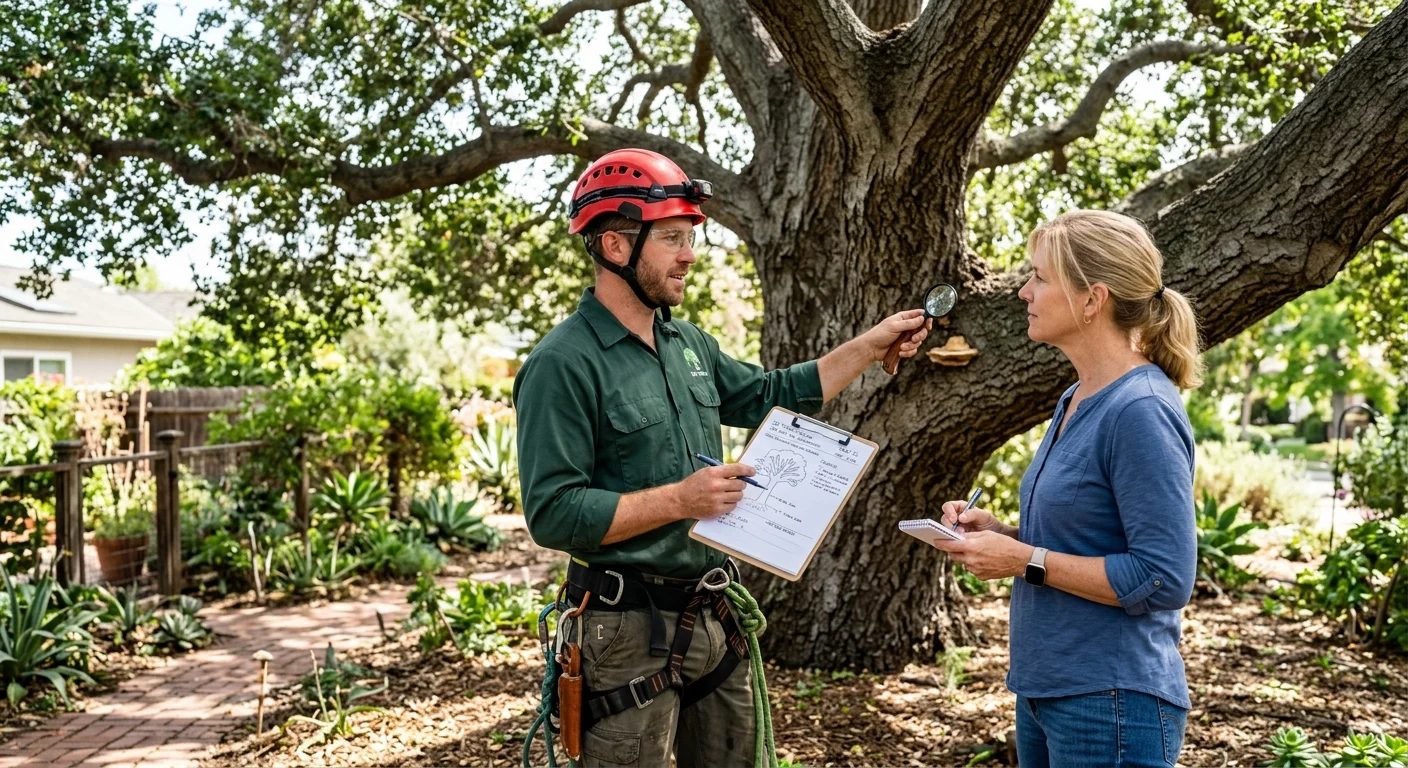
The phrase “arborist and tree surgeon” can make one tree problem sound like two professions. For San Diego homeowners, the useful distinction comes from verified credentials and the proposed work, not the label alone. Diagnosis should come before cutting when the cause or right treatment isn’t clear.
How the two terms are used in tree care
Job titles on a website or truck are not proof. Arborist and tree surgeon are labels people use in ads. Ask the professional to name the exact credential or license behind the title, then check that record for the actual person. Combined wording such as “arborist tree surgeon” does not create a separate credential.
ISA Certified Arborist is a professional certification for a named person. It is not a California contractor license, and it is not permission to operate a contracting business. A C-49 Tree and Palm license covers contracting work such as planting, maintaining, and removing trees and palms, including pruning, stump grinding, and guying. An active legacy C-61/D-49 issued before January 1, 2024 may still be valid for that holder. Do not treat C-49 as the only legitimate class on a current CSLB record.
The word “arborist” by itself doesn’t confirm ISA certification. Likewise, “tree surgeon” doesn’t prove a particular credential, license, or skill level. For a useful working definition, think of a professional offering tree assessment or care. Then verify what that individual can document. Someone assessing decline may need a different assignment from the company completing a defined cutting scope.
That distinction also separates this topic from choosing between an arborist and a tree trimmer. Here, the issue is terminology and proof. The job title should never replace a credential check, a written assessment, or a clear work proposal.
Branch Pro San Diego doesn’t perform tree work or hold these credentials. We connect homeowners with licensed, independent local tree service professionals. The pros we connect you with are licensed and insured.
Match the homeowner’s problem to the needed assessment
Start with the problem you can observe. Don’t start by choosing a title.
A thinning oak canopy, stained bark, or unusual trunk holes calls for assessment before a cutting plan. A visibly broken limb may call for a defined work scope. If your goal is shaping or clearance, discuss the exact branches and purpose with a tree trimming professional.
Location also changes the conversation. A mature tree beside a City Heights driveway presents a different work area from an oak on a larger inland parcel. A tree close to energized lines creates another category of concern.
If a standing tree is in conflict with overhead lines, call SDG&E first. Stay away from a downed line. Call 911 and SDG&E at 1-800-411-7343 from a safe place. A call never authorizes anyone to approach. Ordinary licensed tree contractors are not authorized to work on energized lines. Ask the professional to identify the concern and explain whether the utility or specially trained personnel must handle the next step.
For homeowners seeking tree service in San Diego, useful opening questions include:
- What symptoms or structural concerns can you identify?
- Are you providing an assessment, physical tree work, or both?
- Which credential or license applies to this assignment?
- Will your findings and proposed work be provided separately?
- What remains uncertain after the visual inspection?
A certified arborist consultation fits when you need help understanding the tree before authorizing work. Ask in writing whether the visit includes findings, which trees are in scope, and what is excluded. If the needed work is already clear, the contractor should still explain the cutting scope in writing. Branch Pro does not promise that every matched person holds an ISA credential, or that a written report is included.
The goal isn’t to find the most impressive title. It’s to match the problem with a professional who can document the right qualifications.
How to verify what each title and credential means
Ask for the full credential name, license number, and current status. Then check each item with the organization that issued it.
ISA Certified Arborist is a professional certification, not a California state license. Ask for the person’s full name and current credential. Use ISA’s Trees Are Good resources and the ISA credential directory to check the live record. Don’t rely only on a logo, business card, or verbal claim. A missing public listing does not, by itself, disprove certification. The person can share an ISA digital certificate instead.
Our guide to hiring a certified arborist explains the homeowner screening process in more detail.
Check the professional through the CSLB license lookup. Confirm an active classification that fits the proposed work. That may be C-49, or an active legacy D-49. The record shows the license classification, status, expiration date, bond or security status, and workers’ compensation status.
California’s current minor-work exemption under Business and Professions Code section 7048 is narrow. It applies only when the aggregate project price is less than $1,000, including labor, materials, and other items, the work is casual, minor, or inconsequential, no building permit is required, the person does not advertise as a contractor, and the person does not employ another person to do the work. Splitting contracts to stay under the line disqualifies the exemption. The $1,000 boundary has applied since January 1, 2025. Work that needs a building permit still needs a license regardless of cost.
Read workers’ compensation status on the CSLB record for the license actually offered. Current law excludes D-49 from the no-employee exemption. It does not list C-49 on that same exclusion. Confirm the actual workforce and coverage with CSLB and the insurer. Do not assume every C-49 license must carry coverage, and do not assume none of them do.
A $25,000 contractor license bond has been required since January 1, 2023. A cashier’s check may be deposited in lieu of the bond. Verify the current bond or security on the CSLB record. That bond is not general liability insurance and is not workers’ compensation. CSLB-as-certificate-holder wording applies to certificates filed with CSLB. It does not make a customer certificate invalid merely because you, rather than CSLB, are named.
Don’t treat an ISA credential as a substitute for a required contractor license. Don’t treat a contractor license as proof of ISA certification. One person or company may hold both, but you should verify each separately.
When diagnosis should come before cutting
Diagnosis belongs first when the tree’s symptoms could change the recommended work. Native oaks in San Diego County are a common local example.
The goldspotted oak borer has been present in San Diego County since 2004. UC sources identify coast live oak, California black oak, and canyon live oak among the affected species. Documented signs include crown thinning, dieback, bark staining, D-shaped emergence holes, and bark injury from woodpecker activity.
Those signs deserve an informed assessment. They shouldn’t be converted into a homeowner diagnosis from one photograph or one symptom. Ask the professional which observations support the finding and whether anything remains unconfirmed. Keep suspect oak wood on site until the professional explains current handling rules. Do not move infested firewood as ordinary debris.
Drought stress can leave trees more open to boring insects. UC IPM notes that bark beetles often attack trees weakened by drought, disease, injury, or other stress. Only some aggressive species are the sole cause of death. Healthy trees can withstand limited attacks. A few holes or a damaged branch is not the same as extensive trunk infestation. Ask for identification of the pest, the extent of damage, and the tree’s vigor. Do not treat any beetle sign as a rule that the tree will die.
These local issues show why “cut it back” isn’t always a sufficient explanation. The professional should connect the observed condition to the recommended action. If removal is proposed, ask why treatment or monitoring isn’t advised. If pruning is proposed, ask which concern the cuts address.
Diagnosis also matters when several factors appear together. A leaning trunk, sparse canopy, and insect holes shouldn’t be treated as interchangeable clues. Each observation should appear in the written findings, followed by the professional’s assessment and proposed next step.
What written findings and work scopes should explain
Written findings and a cutting proposal serve different purposes. Ask the professional to keep the distinction clear, even when one company provides both.
A useful assessment should identify the tree and its location. It should record visible symptoms, structural concerns, and relevant site conditions. It should also separate confirmed observations from conclusions that need more investigation.
The proposed work scope should explain:
- Which tree or trees are included
- Which limbs or tree sections are involved
- Whether the recommendation is monitoring, treatment, pruning, or removal
- What concern each recommended action addresses
- Which credential supports the assessment
- Which contractor license covers the physical work
- What isn’t included in the proposal
- Whether another authority must confirm a permit or property rule
Don’t accept “tree surgery” as the entire scope. Ask what will be cut, why it will be cut, and who will complete that work. A clear document gives each professional something specific to discuss before you sign a contract.
Local rules also require careful confirmation. Confirm the parcel city or County jurisdiction, then whether the tree is private, public, heritage-designated, or in a right-of-way. A mailing address is not enough. Do not assume one countywide oak-removal rule from species alone. Ask the city or County Planning & Development Services for that address.
For a City of San Diego public or right-of-way tree, use the City’s street-tree maintenance process. No-fee permit requests follow City inspection. City staff decide immediate safety conditions. Other removals are evaluated under Council Policy 200-5. A private contractor’s availability is not authority to remove a City tree. Report City-maintained trees through Get It Done.
The same caution applies when ownership isn’t clear. Ask the proper public agency about a street tree rather than relying on a job title. For a tree on private property, document its location and the proposed work before comparing contractors.
Branch Pro San Diego matches homeowners with licensed local companies. The homeowner contracts with and pays the independent professional directly.
When to call us
Call when a tree needs diagnosis before pruning, or when written findings point toward licensed tree work. We can connect you with an independent local pro whose credentials you can verify.
Call us at (858) 400-4423 and we’ll connect you with a licensed local tree company. Verify any claimed ISA credential for the named person, and verify the contractor license before you authorize work.