The stump sitting in a future patio or driveway is still in the way of the slab. Stump removal services for hardscape are a coordination job, not a lawn cleanup. You need a written plan for the wood, the roots, the chips, and the grade before the paver crew shows up.
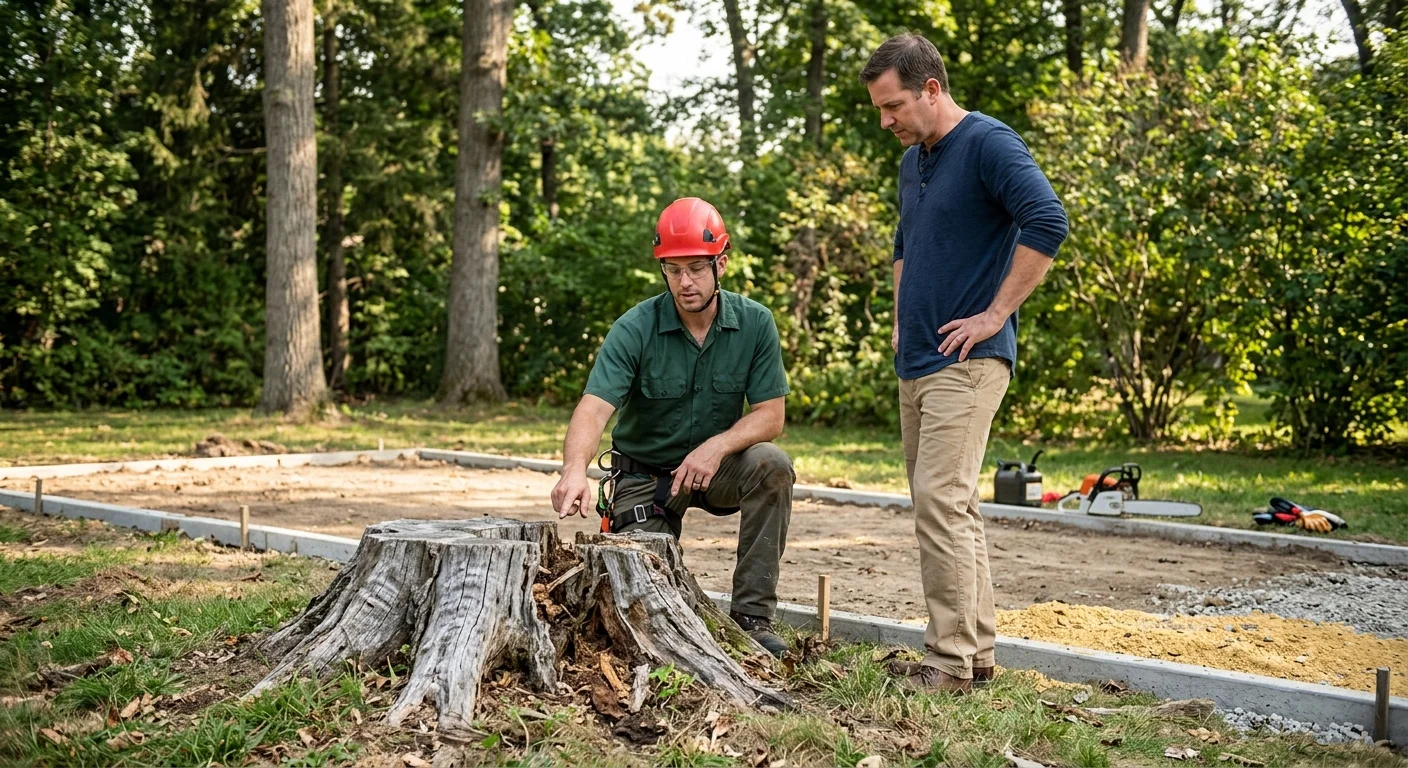
Decide how the cleared space will be used
Start with the finish, not the machine. A lawn patch, a decomposed-granite path, a paver patio, and a poured driveway all tolerate leftover wood differently. Iowa State University Extension notes that decaying wood can leave voids, and that leftover chips, sawdust, and root fragments do not belong in planting soil. That advice is about turf. It is even more relevant under pavers and concrete.
Tell the tree company the end use in plain words. “Grind it so we can seed” is not the same job as “this becomes a driveway apron.” Grinding reduces the visible stump. It does not automatically create a construction pad. Remaining roots, changed soil, and old pest or disease issues still matter if you later plant in the same spot. Grinding alone does not prove the hole is ready.
San Diego yards make this concrete. A queen palm stump in a Clairemont side yard may sit next to a water meter and a tight gate. A eucalyptus stump in Scripps Ranch or Tierrasanta can leave a wide flare and surface roots across a future pad. An older ficus in a City of San Diego front yard may have roots already lifting a walk. East County lots in El Cajon or Santee often have more room for equipment, and more slope to plan around.
If you like the stump as a bench or planter, say so and keep the hardscape off it. Do not pour a slab over wood you plan to deal with later. Wood shrinks as it decays. The finish will follow it down.
If the tree is still standing, stump work comes after tree removal. Get both scopes in writing so the hardscape calendar is not waiting on a leftover trunk.
Document the stump, roots, paving, and irrigation
Walk the work area with a tape and a phone camera before anyone bids. Photograph the stump from the house, from the street, and at ground level. Include the flare, any surface roots, the nearest slab or walk, and irrigation heads. Note the species if you know it. Coast live oak, eucalyptus, and queen palm leave different stumps and different root habits.
Measure what you can from a safe stance. Diameter at the cut, height above grade, and distance to walls, fences, and paving all change access. A walk-behind machine through a Pacific Beach gate is a different visit than a tow-behind unit in Rancho Bernardo. Do not guess underground depth. Paint marks from a locate do not tell you how deep a line sits.
Powered grinding and excavation are not casual backyard digging. DigAlert covers San Diego County. The contractor using powered equipment should call in the locate, wait for responses, and respect the marks. Member utilities usually mark to the meter, not every private irrigation line or sewer lateral. Nonpressurized drains may not be marked at all. Private lines need a separate locate. If the stump sits in a parkway or public right-of-way, stop and confirm ownership. A private contractor’s schedule is not permission to grind a City street-tree stump.
Map drip tubing, valve boxes, and the water meter. Inland lots in Escondido and Vista often run irrigation through old planting beds. Coastal lots in Encinitas and La Jolla often squeeze the stump between a fence and a house. Write those constraints on the quote request so the independent pro is pricing the real site.
Compare grinding and excavation within the project scope
Most residential stump jobs in this county are grinding jobs. A cutter wheel reduces the stump to chips. Lateral roots still remain in the soil. That is usually enough for turf or a planting bed, if chips are pulled out of the hole and the grade is rebuilt. It is not automatically enough under a structural slab.
Excavation pulls more of the stump and a larger share of the root mass. It also opens a bigger hole, disturbs more soil, and creates more haul-off. Use it when the hardscape contractor, or an engineer on a larger job, says remaining wood is a problem for the pavement section. Do not assume excavation means every root is gone. Roots can run well past the hole.
Read the method choice in our stump grinding vs. removal guide. For leftover laterals after the trunk is down, see tree root removal after tree removal. Ask both the tree company and the hardscape company the same question: what wood can stay under this finish, and who is responsible if it shows up later.
There is no verified countywide price list for either method. A provider may quote per inch of diameter, per stump, or as a lump job. Access, slope, species, surface roots, and haul-off change the number. Our pricing explainer walks through those factors. A cheap chemical kit is not a paving plan. Potassium-nitrate stump products aid decay. They are not instant, and they do not by themselves kill a fresh stump. Open burning is a local fire-authority issue, not a default backyard option. San Diego Air Pollution Control District does not issue the burn permit. Do not treat a permissive air-quality day as permission.
California requires a contractor license for tree work, including stump grinding, when the contract is $1,000 or more in the aggregate. The usual classifications are C-49 Tree and Palm, or an active legacy C-61/D-49 issued before 2024. Confirm the named company on the CSLB license lookup. ISA certification is a separate individual credential. It is not the license.
Define hauling, backfill, and the final site condition
Write down who hauls chips, who brings fill, and what “done” looks like. Some owners keep chips as mulch away from the pad. Some want every chip off site. Do not mix leftover chips and sawdust into soil you expect to plant in, and do not assume a raked hole is finished. Decaying wood can leave voids as it breaks down. That is a settlement problem under pavers and a worse problem under a driveway.
Name the fill. Native backfill, import, base rock, and sand are different materials. The tree company may leave a depression. The hardscape company may need a compacted section. Those are not the same finish. Do not ask a stump crew to certify a building pad unless that is actually in their written scope. Turf preparation is not engineered slab preparation.
Agree on remaining surface roots. A root that still ridges the future patio line will telegraph through thin pavers. A root under a deep driveway section may be a different call. Put the call in writing. Grinding also does not erase every sprout. Some species send shoots from roots away from the old stump. Black locust is a documented example. Coast redwood can sprout from a stump or root crown. Watch the area after the visit instead of treating grinding as a guarantee the tree is gone.
If a new tree is part of the design, consider a new hole nearby rather than the old crater. Same-spot planting needs extra prep. It is a landscape decision, not a reason to skip the hardscape spec.
Coordinate stump work with the hardscape contractor
Keep the two contracts separate and sequenced. The independent tree company handles the stump. The hardscape contractor handles base, drainage, and the finish. Meet them on the same afternoon if you can, or send both the same photos and the same sketch. The sketch should show the stump, the proposed patio or driveway edge, irrigation, and the equipment path.
Typical order is locate, stump work, chip and root cleanup, then grade and hardscape. Do not pour first and hope the stump can be ground later from the edge. Do not let a stump quote say “yard ready” if your mason still has to import base. Ask who restores irrigation they cut, who protects existing concrete, and who owns settlement in the first season.
HOA or city paperwork, if any, belongs to the property and the actual jurisdiction. A Rancho Santa Fe Protective Covenant lot is not a City parkway, and a City street tree is not a backyard pepper stump. Confirm the parcel, not just the mailing city.
When the written stump scope matches the hardscape scope, the pad has a better chance of staying flat. That match is the whole point of hiring stump removal services before the mixer shows up.
Frequently asked questions
How much should it cost to remove a stump?
No public agency publishes an official San Diego stump price. Cost follows diameter, access, wood, surface roots, grinding versus excavation, and whether chips and fill are included. Get the measurement method in the quote. Compare written scopes, not a neighbor’s memory of an old invoice.
Is it cheaper to grind or remove a stump?
Grinding is the usual residential method and often disturbs less yard. Excavation can cost more because of digging, haul-off, and a larger hole to rebuild. Cheaper is the wrong test if the finish is a driveway. Price the method your hardscape contractor can actually build on.
How do you remove a tree stump cheaply?
The cheap path is a clear, limited scope on an accessible stump, with chips left or hauled as you choose. Skip chemical shortcuts and backyard fires. Powered work needs a locate. A licensed company for a $1,000-plus contract is the legal baseline, not an upgrade.
What can I do with a large tree stump in my yard?
You can leave it as a feature, grind it for lawn or planting, or excavate it for structure. Paving over an intact stump trades a visible problem for a hidden void. If the stump is in the way of living space, treat the finish as the spec.
When to call us
Call before the hardscape bid is locked, once you know a stump or old roots sit in the pad. The independent tree company needs the end use, the photos, and the access notes so the quote matches the patio or driveway. Call us at (858) 400-4423 and we’ll connect you with a licensed local tree company.