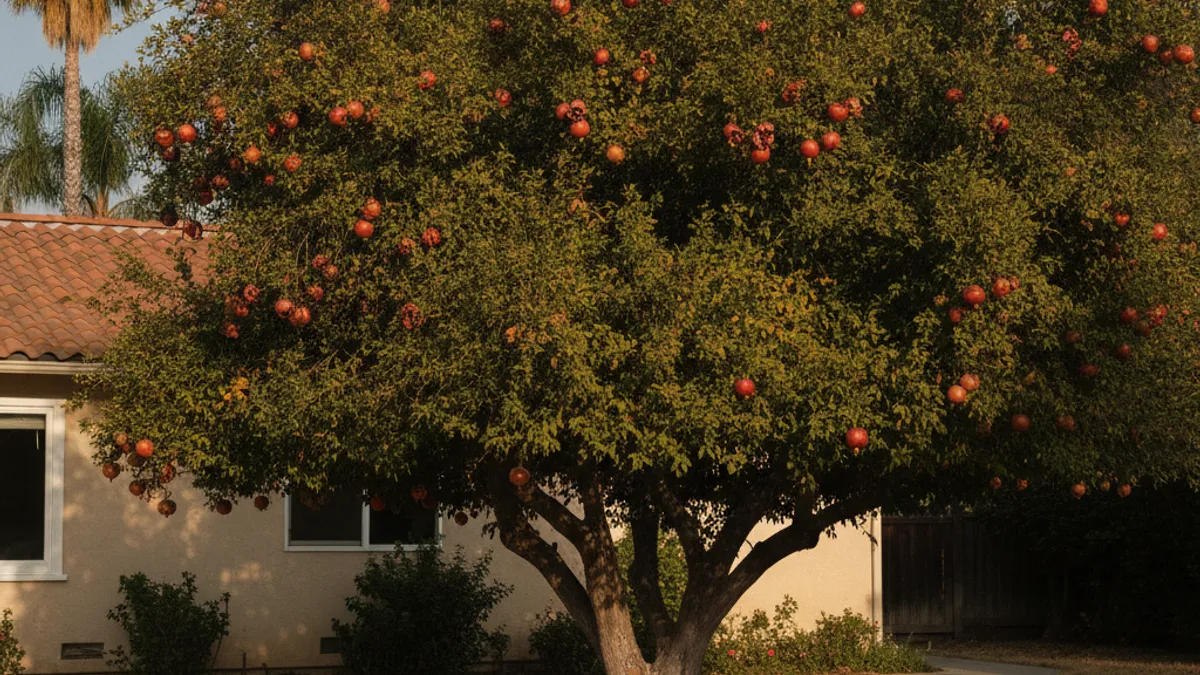
Do the main structural pruning on a San Diego pomegranate in winter. Limit routine summer trimming because branch tips can carry fruit. Keep it as a multi-cane shrub or train it as a tree according to the plant’s structure and your goal. UC Marin Master Gardeners explains the pruning choices.
Illustration of a decorative tree with red fruit.
If the work requires climbing or powered equipment, Branch Pro San Diego can match you with licensed and insured independent local tree service professionals. The professional evaluates the tree and sets the scope, availability, and price. You contract with and pay that professional directly.
Why growing conditions differ across San Diego
San Diego’s coastal and inland yards don’t give pomegranates identical conditions. UC ANR’s production guide says hot, dry interior valleys generally favor fruit quality. Mild coastal summers can limit commercial production, although the plant can still serve an ornamental role.
The same guide identifies deep loam as the preferred soil. Pomegranates tolerate a range of soils, but poor drainage and high alkalinity can reduce growth and yield. Judge the actual planting site instead of following one countywide care schedule.
Cultivar choice also matters. UC IPM’s pomegranate guide distinguishes fruiting cultivars from ornamental cultivars, which may produce mostly inedible fruit. Confirm the cultivar before using its flowers or fruit as evidence of crop potential.
How should you prune a pomegranate?
Start with the intended form. A pomegranate can remain a multi-cane shrub or be trained into a tree. UC Marin Master Gardeners notes that a bush is easier to prune when the base stays about 18 to 24 inches across. A fixed three-to-five-trunk plan isn’t necessary for every plant.
Fruit forms on old spurs and on new wood. UC Marin says those fruiting spurs produce for about three to four years, so keep some sound inner replacement canes as older wood ages.
In winter, work through this list on the actual plant:
- Remove dead, diseased, or damaged canes.
- Remove crossing canes.
- Remove canes that push the base beyond the diameter you can still prune and harvest.
- Remove root suckers.
- Remove outer canes that have sagged close to the ground.
- Thin weaker inner canes so fruit sits on stronger wood, while keeping replacements for aging spurs.
Limit routine summer trimming because branch tips can carry fruit. UC Marin advises skipping general summer pruning unless growth has become excessive or dysfunctional. Cutting every outer tip can remove fruiting wood without improving the plant’s structure.
For other species in your yard, use our tree pruning calendar for San Diego as a starting point. Each tree still needs a species-specific assessment.
What causes pomegranate fruit to split?
Ripe pomegranates can split naturally. UC Master Gardeners of Placer County notes that rain can spoil fruit after it opens.
Inspect fruit maturity, recent weather, irrigation patterns, and drainage together. A crack alone doesn’t identify why the fruit opened, so avoid changing several parts of the care plan at once.
Which pests and diseases should you check?
Possible pomegranate pests include leaffooted bugs, mealybugs, scale, and whiteflies. UC IPM also identifies Armillaria and Botrytis as possible diseases. These are possibilities, not proof that a particular problem is present in a San Diego yard.
Inspect the fruit, both sides of the leaves, stems, and the plant’s base. Note whether the damage is spreading and whether insects are actually present. Avoid choosing a treatment from one symptom alone. Our guide to common tree pests in San Diego can help you organize what you’re seeing before requesting an assessment.
How do you judge harvest timing?
Don’t rely on a fixed San Diego harvest month. Ripeness varies with the cultivar, bloom, and weather. Characteristic cultivar color, a more angular shape, and the sound produced when the fruit is tapped can all provide clues, according to UC Master Gardeners.
Pomegranates don’t continue ripening after harvest. UC Davis describes the fruit as non-climacteric, so pick it when it is ripe rather than expecting it to improve on the counter. Clip the stem instead of pulling the fruit from the branch.
What makes a suitable planting site?
Start with drainage. Pomegranates tolerate several soil types, but poor drainage can interfere with growth and yield. High alkalinity can also cause problems. Check how water moves through the proposed site before planting.
Leave enough working room for the form you intend to maintain. Use cultivar-specific information from the nursery or grower when planning clearance. A universal setback or mature width doesn’t fit every pomegranate cultivar and training method.
Should you fertilize on a schedule?
Don’t default to an automatic balanced-fertilizer application. UC IPM’s fertilizer guidance says many established woody plants need no routine fertilizer, although fruiting plants can be exceptions. Fertilize when the plant and site show an actual need.
Excess fertilizer can create more growth, pruning, water demand, and pest pressure. If growth or fruiting changes, consider irrigation, drainage, salts, pests, and disease before treating fertilizer as the only answer.
Frequently asked questions
When should you prune a pomegranate tree in San Diego?
Use winter for structural pruning. Preserve useful fruiting wood, and limit summer cuts to growth that has become excessive or dysfunctional.
Does every pomegranate need a vase shape?
No single form fits every plant. Pomegranates naturally grow as multi-cane shrubs and can be trained as trees. Choose a structure that suits the plant’s condition, available space, and intended use.
Why is my pomegranate fruit splitting?
Ripe fruit can split, and rain can spoil fruit after it opens. Check maturity, recent weather, irrigation patterns, and drainage before changing the care plan.
How much water does a pomegranate need?
There isn’t one useful countywide amount. Soil, drainage, weather, container conditions, plant size, and fruit development affect the watering plan. Check actual soil moisture and avoid both prolonged stress and poor drainage.
Which pests can affect a pomegranate?
UC IPM lists leaffooted bugs, mealybugs, scale, and whiteflies among the possibilities. Confirm the insect and the damage before choosing a response.
If your pomegranate needs structural pruning or has damage you can’t identify, call Branch Pro San Diego at (858) 400-4423. We’ll connect you with an independent local professional who can assess the actual tree.