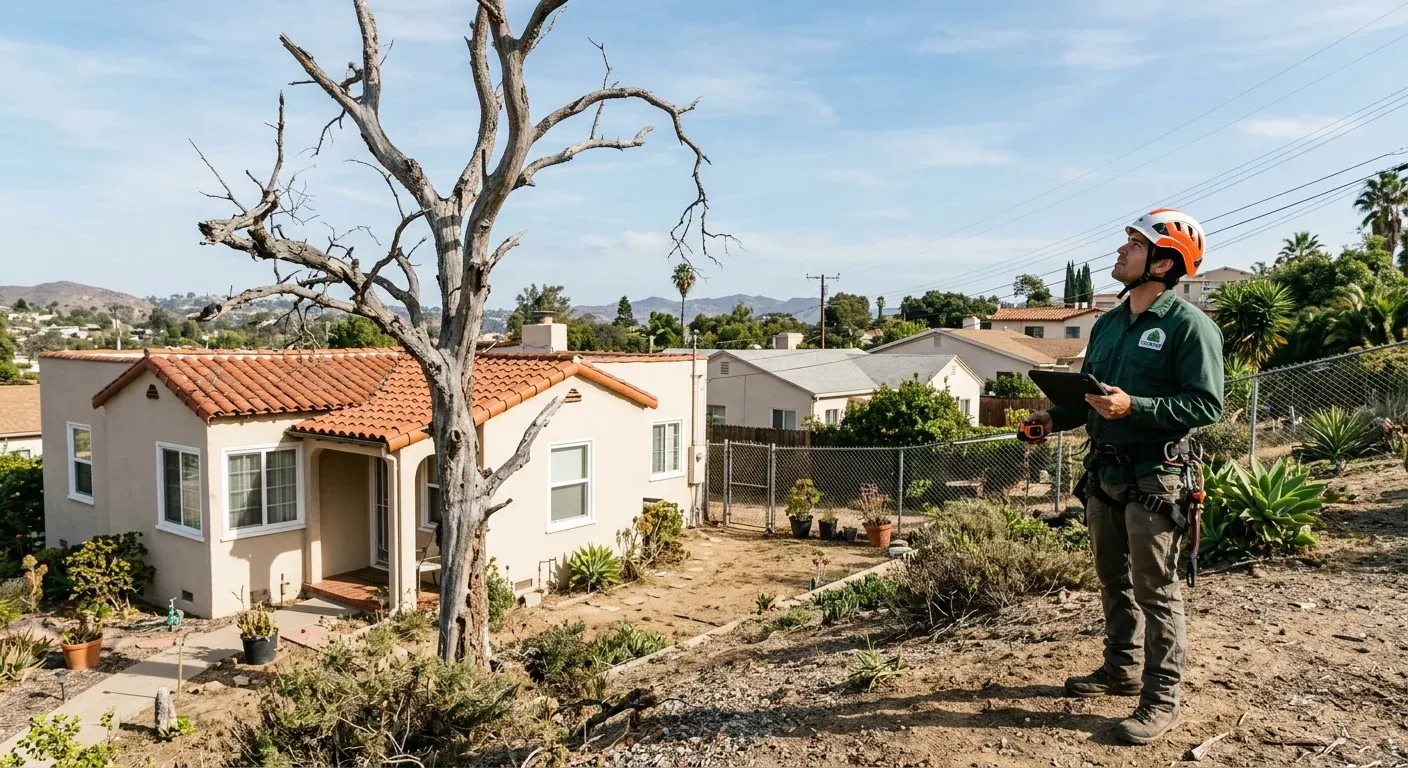
A professional assessment can support removal when the tree is dead and the site warrants it. A useful quote should then address condition, nearby obstacles, equipment access, stump plans, and cleanup.
If a line is down, stay away. Call 911 and SDG&E at 1-800-411-7343 from a safe place, and wait for the utility’s direction. A standing tree against a line goes to SDG&E first. Injuries and other immediate danger also go to 911. Don’t walk under the dead canopy to inspect it. Share photos only if you already have them from a ground-level view outside the risk zone.
How a pro confirms the tree is dead
Dead tree removal starts with confirming that removal is the right plan. Even when the canopy looks lifeless, an independent tree professional should inspect the whole tree from a controlled position. The assessment should cover the trunk, major limbs, root area, and recent changes around the site.
Tell the professional who identified the tree as dead or nearly dead. Share any written diagnosis, photos taken from a safe vantage, or earlier treatment records. Also explain whether the change happened gradually or followed wind, digging, irrigation changes, or construction.
If you’re still deciding what you’re seeing from a safe distance, review the signs that a tree is dying. If treatment remains under consideration, the removal versus treatment guide covers that earlier decision.
Species and location can shape the conversation. A professional may see coast live oaks with goldspotted oak borer signs: crown thinning, bark staining, D-shaped emergence holes, and woodpecker foraging. Those clues aren’t a diagnosis by themselves, and they don’t mean every affected oak is already dead. UC ANR records the pest in San Diego, Riverside, Orange, Los Angeles, San Bernardino, and Ventura counties. Drought-stressed trees can also face boring insects. Extent of damage and tree vigor still matter.
Ask the professional to state the conclusion clearly. Is the entire tree dead, or only part of its canopy? Is remaining wood sound enough for climbing or rigging, or does condition rule those methods out? Does the professional recommend another opinion before removal?
An ISA Certified Arborist credential can show individual competency in tree care. It isn’t a California contractor license, and it isn’t proof that every referred worker holds it. Homeowners can use ISA’s arborist resources and ask the actual person for a digital certificate when that credential matters.
How trunk, root, and canopy condition shape the plan
A removal plan should describe how the tree will come apart. The trunk, roots, and canopy each affect that discussion. Dead tree removal isn’t one standard sequence for every yard.
Ask what the professional observed at the trunk base. Visible cavities, splits, loose bark, past cuts, and damaged areas should appear in the site notes. The professional should also inspect the root flare and nearby soil without promising what can’t be seen underground.
Recent trenching, grade changes, paving, or irrigation work may matter. Point those out from a safe standing place. In a narrow City Heights yard, that could include a new fence or walkway. On a larger Poway or Ramona parcel, it could involve a driveway, slope, or fuel-management work.
Canopy shape matters too. A tall bare trunk with limited branching is a different setup from a broad eucalyptus over several properties. A dead queen palm brings another shape and debris pattern. The quote should identify which limbs need controlled lowering and where cut material can land.
Ask these planning questions:
- Will the professional climb, use an aerial lift, or work from the ground?
- Which parts can be lowered into a clear drop zone?
- Does trunk condition limit climbing or rigging options?
- Where will limbs and trunk sections be staged?
- Could equipment cross irrigation, paving, or planted areas?
The answers should match the actual site. Climbing and rigging choices belong to the company doing the work. A tree removal service proposal should explain the selected approach without hiding major assumptions. If access depends on a gate, driveway, neighbor’s property, or cleared parking area, get that condition written into the quote.
What nearby roofs, fences, and utility lines change
Dead trees rarely stand in an empty field. San Diego properties often place them beside roofs, walls, fences, driveways, pools, or neighboring yards. The professional should walk the work area. You don’t need to pace under the canopy to make that list.
From a safe vantage, identify roof edges, solar arrays, sheds, walls, fences, parked vehicles, and planted areas that sit in the likely drop or haul path. Ask where cut material will be staged, whether it gets hauled, and what the endpoint is. Don’t assume every quote includes moving wood to the street.
Property boundaries deserve attention. If limbs extend over a neighboring yard, discuss access before work is scheduled. Don’t assume a professional can enter another property or move items there. Written permission may be needed, depending on the access plan.
If the tree contacts or could reach power lines, don’t call a tree crew first to handle the wires. Stay away. For a standing tree in or near lines, call SDG&E first. For a downed line, call 911 and SDG&E at 1-800-411-7343 from a safe place. Immediate danger or injury also goes to 911. Follow SDG&E’s downed-line guidance. The utility decides whether lines can be de-energized, covered, or moved. Only then does ordinary private tree work proceed. Our guide to trees near power lines in San Diego explains why a standard removal plan may not fit.
Permit rules depend on who owns the tree and where it stands. In the City of San Diego, street-tree removal, trimming, planting, and root pruning need a no-fee permit after City inspection. Report City-maintained trees through Get It Done. City staff judge immediate safety. Other City street-tree removals are reviewed under Council Policy 200-5. A dead City tree isn’t a blanket exemption, and a private contractor’s schedule isn’t authority to cut it. On a private parcel, still check easements, protected-tree rules, and the actual city or County jurisdiction. A mailing address isn’t enough. Homeowners in the city can start with our San Diego tree service page.
When crane access may enter the discussion
Crane access may enter the discussion when a professional can’t safely lower sections through the available space with the planned ground or climbing setup. That doesn’t mean every tall dead tree needs a crane. The decision should follow a site assessment and a written removal plan. A crane isn’t a guaranteed benefit.
The professional should explain what the crane would solve. It might offer another way to move sections around a roof, wall, pool, steep bank, or restricted drop zone. The tree’s condition also matters, because compromised wood can change climbing and rigging choices.
California crane setup rules look at ground support: slope, compaction, firmness, drainage, and the manufacturer’s setup requirements. Suitable supporting materials may be needed. Known or documented subsurface voids, tanks, and utilities must be communicated. Mats and cribbing don’t guarantee the property won’t be marked. Ask where the crane would stand, how it would enter, and where lifted sections would land.
A crane discussion should cover:
- The proposed setup location and ground conditions
- The path used to bring equipment onto the site
- The area needed to receive tree sections
- Any access the homeowner must arrange
- Which items must be moved before work
- Whether the crane operator is included in the written scope
Don’t treat a crane mention as a complete explanation. Ask what alternatives were considered and why the proposed method fits your property. A narrow La Jolla lot, a Mission Valley slope, and an inland East County parcel can present very different access questions.
Our crane-assisted tree removal service page explains how we connect homeowners with local professionals for these projects. The matched company should inspect the site and decide whether crane assistance belongs in its plan.
What stump and cleanup choices belong in the quote
The tree may be gone while the stump, surface roots, chips, and trunk sections remain. Make every cleanup choice part of the written quote.
Start with the stump. Ask whether the proposal includes leaving it in place, cutting it lower, grinding it, or excavating more of the root mass. These are different scopes. The quote should state the selected option and describe what happens to the resulting material.
Future plans help define the request. Tell the professional if the area will become a walkway, planting bed, fence line, lawn, or construction zone. Stump grinding doesn’t prepare a site for a foundation or slab. It also doesn’t remove the full root system. Remaining roots, altered soil, and earlier pests or disease still matter if you want to replant in the same spot. A nearby planting location can avoid some of those problems.
Wood chips aren’t soil fill and they aren’t structural backfill. Remove excess wood and chips from the planting area, then correct soil and settlement. Surface mulch is a separate choice if it fits the end use. Decaying wood can leave voids. Ask who is responsible for final grade, settlement, and any later restoration.
Before powered grinding or other disturbance, contact DigAlert at 811. DigAlert covers San Diego County. Utility members mark facilities they own, usually to the meter. Marks don’t show depth. They don’t cover all private irrigation, sewer laterals, or other private lines. Those need a separate locate. Wait for all responses, then respect the marks. Don’t assume buried lines are deep enough to grind over.
Then define the debris plan. The written scope should say whether the tree company will haul away branches, trunk sections, and grindings. If you want logs or wood chips left on the property, specify the amount and placement. If the tree is an oak with suspected goldspotted oak borer damage, keep suspect wood on site until a qualified professional arranges handling that matches current UC guidance. Moving infested firewood is a known path for new infestations. Confirm actual disposal rules for the load. Don’t move suspect oak wood to another yard. Cleanup included is too vague when access is tight.
Also ask about:
- Raking and removal of small debris
- Protection of the access path
- Moving and replacing gates or fence panels
- Soil or mulch used at the stump area, and who owns settlement risk
- Handling of surface roots outside the grinding area
- Final walkthrough before equipment leaves
Ask for a written site quote and compare those endpoints. The independent company sets its own price after seeing the property.
Before hiring, check the responsible professional through the CSLB license lookup. For this work, look for a current C-49 classification or an active legacy C-61/D-49 license, plus current license status and the coverage records shown there.
When to call us
Call when a dead tree stands near a home, fence, or restricted access point, the lines are clear of the work, and you need a written removal plan. If a standing tree is in or near lines, call SDG&E first. If a line is down, stay away and call 911 and SDG&E at 1-800-411-7343 from a safe place. Injuries and other immediate danger also go to 911. Branch Pro San Diego matches you with licensed, insured independent local tree companies. You hire and pay the professional directly.
Call us at (858) 400-4423 and we’ll connect you with a licensed local tree company.