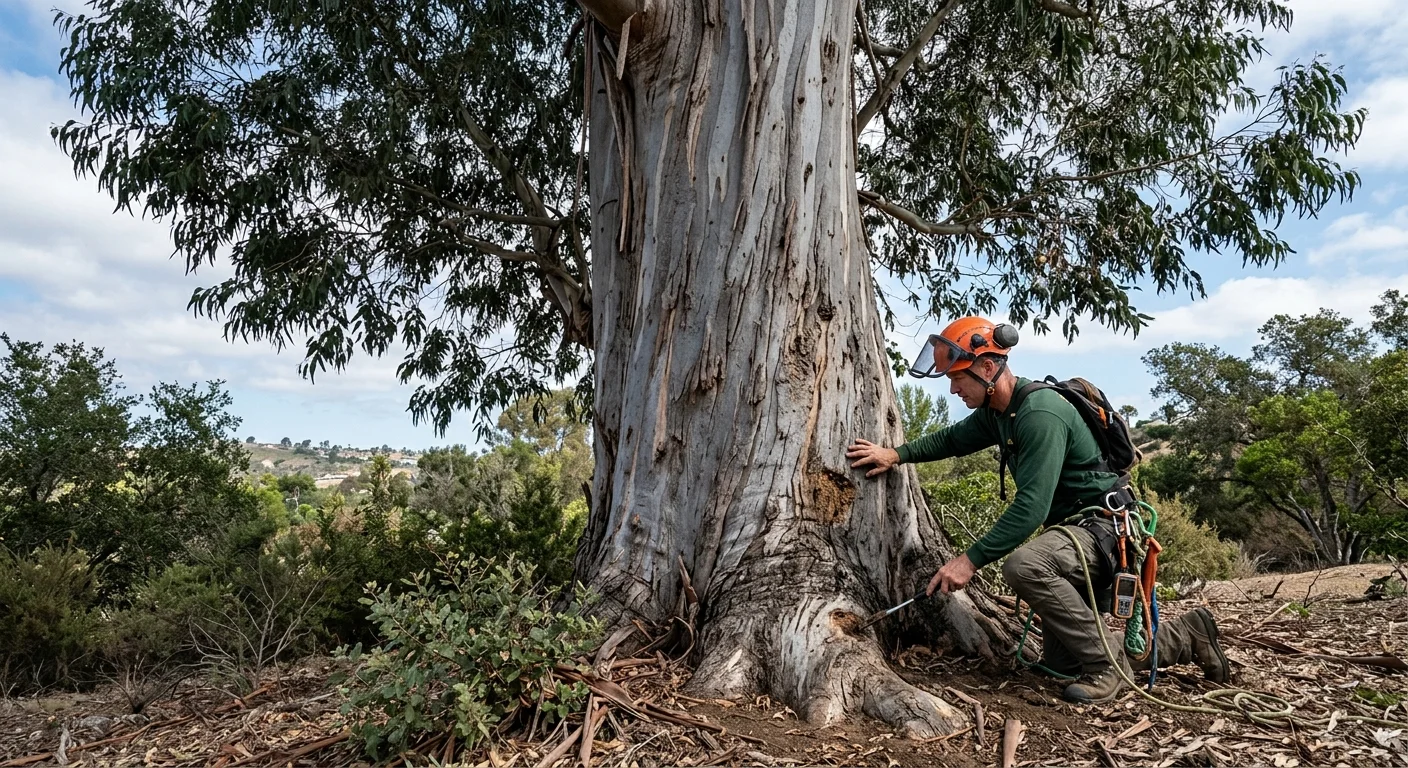
A suspected blue gum should be identified before pruning, treatment, or removal. Eucalyptus globulus subsp. globulus has a few field characters you can photograph from the ground. Those characters are reference points, not a remote diagnosis. Ask for an on-site botanical name before consequential work.
Confirm the species before making a care decision
Start by separating the tree’s identity from its condition. A tree can look unhealthy without its species being clear. A familiar common name isn’t enough to confirm Eucalyptus globulus.
EUCLID, the Centre for Plant Biodiversity Research identification work, describes the nominotypical subspecies this way. The trunk is mostly smooth and sheds in broad strips. Rough bark can linger at the base. Juvenile leaves are opposite, stem-clasping, and blue or waxy. Adult leaves are alternate, stalked, and glossy lance or sickle shaped. Buds are usually a single large warty bud. The woody capsule is ribbed and sits without a fruit stalk. Read the EUCLID description of Eucalyptus globulus subsp. globulus as a comparison, not as a guarantee that your tree matches.
Other Eucalyptus globulus subspecies carry buds in threes or sevens. A single bud is not a whole-species test. Use several characters together: bark extent, juvenile and adult leaves, buds, and capsules. Bark color alone is a weak clue. Fallen fruit in a mixed stand may belong to another tree. This page cannot certify the tree from a photo.
Photograph the entire tree from several accessible directions. Stay on stable ground. If trunk, bark, leaves, branch tips, seed structures, or the soil line are already visible from that safe viewpoint, include them. Don’t walk up to a suspect tree for a closer shot, and don’t place an object beside it for scale. Don’t climb, peel bark, or probe openings.
Write down where the tree grows. Note whether it’s alone, part of a row, or inside a larger stand. Record nearby fences, roofs, streets, slopes, retaining walls, and utility lines. Those details help a local professional understand the setting before discussing work.
Don’t rely on a phone app or one online photograph as final confirmation. Ask the professional to explain which features support the identification. If the name remains uncertain, have that uncertainty written into the assessment. Our San Diego eucalyptus identification guide can help you organize the same observations.
An ISA Certified Arborist credential shows professional competency in tree care. It isn’t a California contractor license, and it belongs to a person, not a company. The ISA consumer resources can help owners understand that distinction. An ISA directory listing can be omitted, so an absent listing doesn’t settle the question. Ask the person for a current digital certificate if that credential matters to you. It does not prove the credentials of every professional we connect you with.
Document changes in the canopy, trunk, and root area
A useful tree record describes visible changes without assigning a cause. Begin with dated photographs from consistent positions. Repeat the same views when something changes. This gives the examining professional a clearer sequence than memory alone.
For the canopy, record where foliage looks different. Note whether the change affects one branch, one side, the top, or most of the crown. Photograph hanging, cracked, or recently fallen branches from a safe distance. Don’t stand beneath a damaged branch to get a closer image.
For the trunk, photograph visible openings, stains, loose bark, cavities, unusual growth, and damaged areas. Describe what you see in plain words. Avoid calling something disease, decay, or insect damage unless a qualified professional confirms it.
At ground level, document changes near the trunk and visible roots. Include soil disturbance, trenching, paving, irrigation changes, stored materials, and recent construction in your notes. Record when each change occurred if you know.
The same checklist works across San Diego County, but the site description should stay specific. A coastal North County yard isn’t the same inspection setting as an inland East County parcel. Central San Diego, South Bay, and rural properties also present different surroundings. Describe the actual property instead of choosing a regional label alone.
For several eucalyptus on one parcel, keep a separate record for each tree. Our eucalyptus grove management guide can help organize a broader site review without treating every trunk as one case.
How tree placement affects pruning discussions
Placement shapes the questions an owner should bring to an assessment. Before discussing cuts, map what sits beneath and beside the tree. Include buildings, parked vehicles, play areas, neighboring property, utility equipment, and regular walking routes.
Take photographs from a safe, accessible viewpoint toward the tree, including shots that show the house and the tree in the same frame when you can do that without approaching the trunk. If access is narrow, photograph gates, side yards, overhead wires, and nearby structures from those same safe positions. These images don’t determine a work plan. They help a local tree company understand what needs an on-site review.
If a standing tree is in conflict with a power line, contact SDG&E first. Don’t approach the lines or move ladders and long tools into that area. Ordinary tree companies don’t control energized conductors. If a line is down, stay away. Call 911 and SDG&E at 1-800-411-7343 from a safe place. A phone call never authorizes you to walk closer. Immediate danger also goes to 911.
Fire-zone requirements depend on the property’s official designation. California Public Resources Code 4291 requires defensible space around structures in State Responsibility Areas. The requirement extends 100 feet or to the property line, whichever is less. Locally designated Very High Fire Hazard Severity Zones follow Government Code 51182, with property-line limits and other parcel-specific qualifiers. That is not every locally regulated parcel by default. Some local jurisdictions may apply stricter rules. Check the property’s current designation and local requirements through CAL FIRE’s wildfire preparation resources, then confirm them with the fire authority for that address.
The first five feet around a structure is described as an ember-resistant zone. Ready for Wildfire says a statewide Zone 0 rule is not legally required yet. The Board of Forestry approved a final draft on August 19, 2026. As of September 5, 2026, the Office of Administrative Law listed that package under review. City of San Diego guidance can already apply on City parcels and allows maintained trees in that first five feet. Don’t treat that City guide as a countywide removal order, and don’t turn fire rules into a blue-gum cut list.
Owners within the city can use our San Diego tree service connection page when an on-site review is needed.
When declining growth needs an on-site assessment
Call for an assessment when the tree’s appearance changes and the cause isn’t confirmed. Useful examples include thinning foliage, dead-looking sections, new trunk damage, fallen branches, or changes around the root area. These are observations to document, not diagnoses.
Bring your photographs, dates, and property notes to the appointment. Mention excavation, paving, irrigation changes, storms, nearby work, or previous pruning if those events occurred. Don’t guess when an event happened. Mark the date as unknown when you can’t confirm it.
Ask the tree professional to address four separate points:
- Is the tree’s identity confirmed?
- Which observations matter most?
- What additional inspection is needed?
- Which options deserve a written scope?
A visual assessment shouldn’t be presented as certainty when the cause remains unconfirmed. Ask what could be established during the visit and what couldn’t. If testing or another specialist is suggested, request an explanation of its purpose before approving it.
Our tree health diagnosis and treatment connection is intended for owners who need a licensed local professional. Branch Pro San Diego makes the connection. The professional evaluates the tree and discusses any proposed work directly with you.
Check credentials according to the proposed scope. ISA certification is a professional credential, not state authorization to contract. California tree contracting generally requires an active C-49 Tree and Palm license or an active legacy C-61/D-49 when the contract is $1,000 or more in the aggregate, including labor, materials, and all other items. The minor-work exemption is only for casual, minor, or inconsequential work under that amount, with no building permit. It does not apply if the person advertises as a contractor, employs someone else to do the work, or splits jobs to stay under the limit. Work that needs a building permit needs a license regardless of cost. You can confirm classification, status, expiration, the $25,000 license bond or cashier’s-check security, and the workers’ compensation record through the official CSLB license lookup. Current law lists D-49 among classifications that cannot use a no-employee workers’ compensation exemption. It does not list C-49 in that same exclusion. Confirm the actual workforce and coverage with CSLB and the insurer rather than assuming either way.
When management and removal become separate options
Management and removal should appear as separate options in the written discussion. Don’t let an uncertain identification or unexplained symptom become an automatic removal decision. Ask what each option addresses, what remains uncertain, and what future observations would change the recommendation.
For a management proposal, request a defined scope. It should identify the tree, the areas involved, and the proposed work. Ask the professional to explain how progress will be reviewed. Ask what each option can and cannot establish about the tree’s later condition.
A removal discussion needs its own site review. Placement, access, utility lines, neighboring property, and surrounding structures belong in that conversation. If removal is being considered, our eucalyptus removal and management service can connect you with a licensed independent local company.
Bird protections also affect scheduling. Occupied nests and eggs are protected whenever they are present. California Department of Fish and Wildlife describes February through August as typical for many species. Nesting can occur year-round in some places. When birds could be nesting, CDFW recommends a consulting biologist’s survey before vegetation removal. The biologist may set a protective buffer, or work can wait until nesting is complete. Don’t move or inspect a nest yourself. No calendar date proves a nest is inactive.
Before signing, verify the business through CSLB. Confirm that the license is active and shows a classification that fits the work. Review the written scope from the tree company, including which tree is involved and which option you’ve selected. Branch Pro San Diego doesn’t perform the work, set the contractor’s price, or provide the contractor’s warranty.
When to call us
A licensed tree service pro should assess a suspected blue gum when its identity, condition, placement, or management options remain unclear. Call us at (858) 400-4423 and we’ll connect you with a licensed local tree company.