The eucalyptus over the garage is the easy part of the sentence. Getting a crew, a chipper, and the wood off a Vista hillside lot is the real plan. Vista tree service for tree removal starts with access: the hill, the gate, the roof, and the street.
Why the tree may need removal
A Vista tree removal is a decision about risk, space, and what the tree is doing to the house. Dead wood over a patio, a lean toward the roof, a trunk splitting at a weak union, or roots lifting a walk are common reasons to take it down. Inland North County heat and Santa Ana winds add load to trees that already look tired. A green canopy does not prove the wood or the roots are sound.
Coast live oaks, eucalyptus, and pines show up on many Vista lots. Oaks with thinning crowns, staining, or D-shaped exit holes need a real on-site diagnosis, not a guess from a photo. Goldspotted oak borer is contributing to oak mortality in many areas throughout San Diego County. That is a reason to have the tree assessed. It is not a remote diagnosis, and it is not an automatic order to cut.
Palms are a different plant and a different job. If the palm is staying and you only need dead fronds and fruit off the crown, that is palm trimming in Vista, not a removal. If the palm is failing or sitting in the wrong place, the independent crew treats it as a removal with its own drop zone and haul plan.
Do not climb, winch, or drop a large tree toward the house. Work near overhead lines is not a homeowner task. If a line is down, stay back, call 911, and call SDG&E at 1-800-411-7343. The utility decides whether the line can be de-energized, covered, or moved. Ordinary tree work waits until that is settled.
Ask for a written assessment that names the tree, the targets it could hit, and whether pruning, support, or removal is the actual recommendation. Independent licensed professionals do the physical work. Branch Pro San Diego matches you with those pros. We do not cut, haul, or grind.
How Vista hills, heat, and gated tracts change the plan
Vista sits inland of Oceanside and Carlsbad. Summer heat is higher, the marine layer is thinner, and west-facing banks dry out faster. That does not mean every inland tree must come down. It does mean a removal quote should account for dry soil under outriggers, wood that can fail in pieces, and a haul path that does not chew a steep drive.
The lot shape changes more than the city name. Shadowridge, in south Vista around the golf course and planned tracts, often means cul-de-sacs, HOA gates, visitor lists, and tight turns for a chipper or dump trailer. Downtown Vista, around Vista Village Drive and the civic core, has older, smaller lots and closer neighbors. A drop zone that works on a Shadowridge pad may not exist behind a downtown garage. Buena Creek and the northern draws run more rural: longer private drives, steeper grades, and more room in the yard but less room on the road.
Gated tracts add logistics, not extra tree biology. The independent company needs a working gate code or a listed contact, a place to stage, and a path that does not block the only exit. If an HOA controls street trees or a parkway, that is a separate permission path from a backyard tree you own. Confirm who owns the trunk before anyone prices the job.
Heat changes how the crew works the slope. It does not create a published arrival window, and this brand does not promise one. Ask how they will hold chips and logs on a grade so nothing rolls into a fence or the downhill neighbor. Vista tree services on inland lots fail when that downhill path is an afterthought.
If the tree sits in a right-of-way, Vista’s Urban Forest program is the authority, not the contractor’s calendar. The city says right-of-way trees require its no-fee removal permit. Private ownership and right-of-way location can coexist, so a tree you water can still sit in city control. Confirm the address and the tree’s location with the city before you approve a cut. Start with the current Vista Urban Forest Management page. Do not treat fire-clearance advice as permission to remove a right-of-way tree.
Map roofs, slopes, gates, and street access
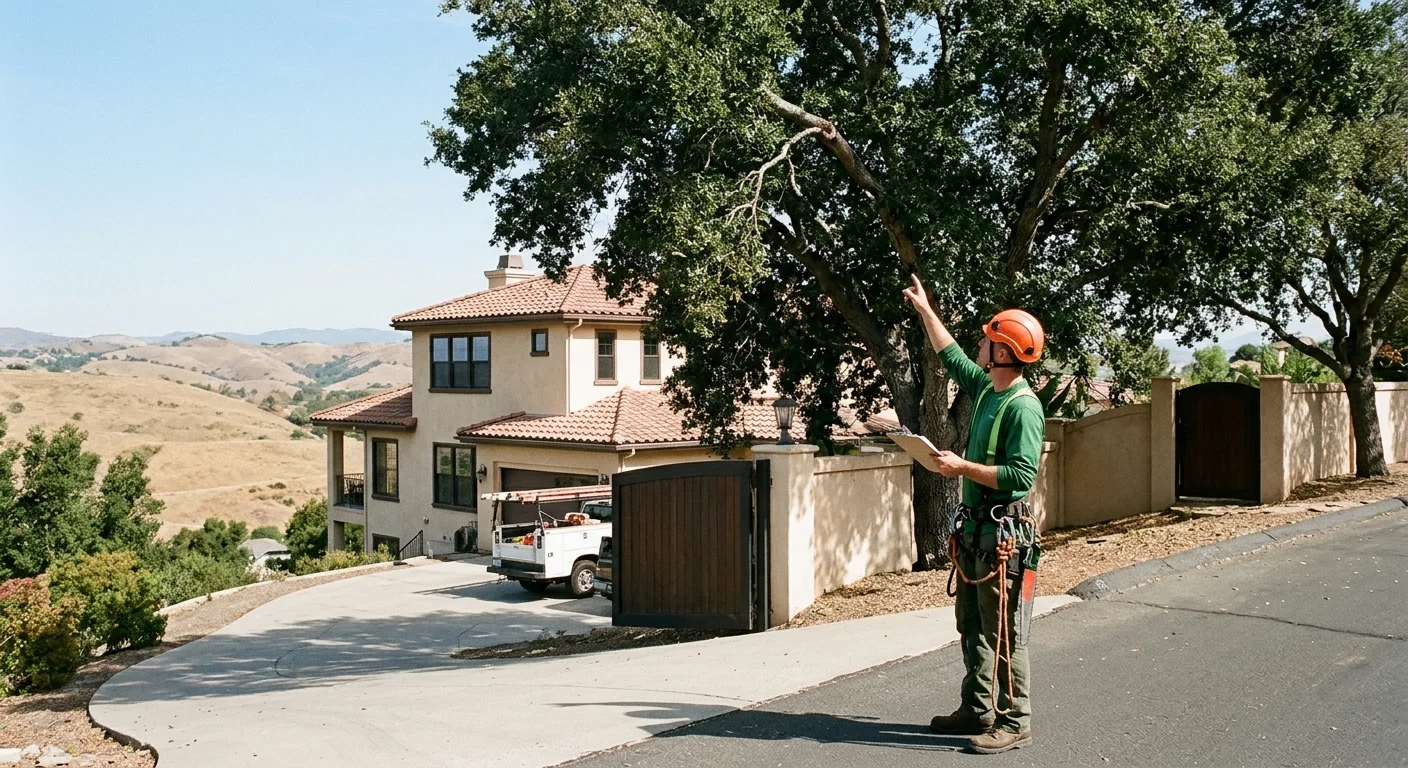
Walk the property with the independent estimator the way the wood will leave, not the way you walk the dog. Start at the street. Note parking, hydrants, mailboxes, and whether a trailer can sit without blocking the only lane. Then the driveway grade, the side-yard width, and every gate. A side gate that fits a person will not pass a chipper or a stump grinder.
Mark the roof edges, skylights, solar, patio covers, and the neighbor’s structure. A tree that looks “in the back” can still fail toward the house if the lean and the slope agree. Photograph from the ground, from a safe place. Do not get on the roof or stand under hung-up limbs for a better shot.
On a hillside, the fall line is the planning line. Wood wants to roll. Fences, pool cages, AC pads, and the downhill yard all sit in that path. Ask how the crew will piece the tree, lower wood, or use a crane if ground access is too tight. A crane is a method, not a default. Ground support depends on slope, compaction, drainage, and what sits under the pads. Known tanks, septic, and utilities have to be on the table before anyone sets a machine.
If stump work or excavation is in the quote, DigAlert covers San Diego County. Public marks usually run to the meter. They do not locate every private irrigation line, sewer lateral, or low-voltage run, and they do not give depth. Private locates are a separate arrangement. Do not assume the stump is clear because the yard looks empty.
Power lines change the whole map. Do not classify wires by height or color. Call SDG&E when lines obstruct the work or when anything is down. The independent tree company is not the line operator.
Write the access notes into the quote: gate width, slope, staging, drop zone, and haul route. If those lines are blank, tree removal in Vista CA is still a guess.
Separate cutting, hauling, stump work, and cleanup
Tree removal is several jobs sold as one sentence. Cutting is the tree coming down in a controlled sequence. Hauling is wood, brush, and chips leaving the lot. Stump grinding is a different machine, a different access problem, and often a different visit. Cleanup is what “broom clean” actually means on decomposed granite versus lawn.
Ask each item to stand on its own in the written scope. A low bid that leaves a tall trunk, a pile of rounds, and a stump is not the same job as a full takedown with haul-off. If you want firewood left, say so. If you want the hole filled and graded, say so. Grinding does not make the spot ready to plant. Remaining roots, chips, and settlement still have to be handled. Same-spot replanting needs its own plan.
On Vista hills, haul-out is often the bottleneck. A crew can section a tree in a tight side yard and still have no safe path for a loaded trailer. Confirm where trucks park, how wood leaves the slope, and who protects the drive. Chips left as mulch are a choice, not a default. Do not pile chips against the house. Confirm current defensible-space rules with the fire authority that covers your parcel. Statewide Zone 0 rules were still in state review as of early September 2026, and local fire departments can be stricter. CAL FIRE’s Ready for Wildfire guidance is the public starting point. It is not a permit to clear a neighbor’s land or a protected right-of-way tree.
Nesting birds are protected year-round. CDFW describes February through August as typical nesting season for many species, with variation by species and location, and nesting in some places every month. If work must happen when birds could be nesting, a consulting biologist’s survey is the agency’s guidance. Do not move nests.
What to verify with the independent contractor before approval
California requires a contractor license for tree work contracts of $1,000 or more, including labor, materials, and all other items. The current tree classification is C-49 Tree and Palm Contractor. A contractor with an active legacy C-61/D-49 issued before 2024 may still work under that classification. Do not treat a missing C-49 as automatic proof the company is illegal, and do not treat a C-49 as proof the person on site is qualified for electrical clearance.
Look the license up yourself on the CSLB license lookup. Check classification, active status, and the contractor bond record. Every active California contractor must carry a $25,000 contractor license bond, or a lawful deposit in lieu of the bond. That bond is not general liability and not workers’ compensation. Ask for the actual insurance, and remember a certificate is not the policy. Coverage follows the policy terms.
Workers’ compensation depends on how the job is staffed. A C-49 holder is neither automatically required to carry coverage nor automatically exempt. Confirm the CSLB workers’ compensation record and ask who will be on site. Coverage is mandatory when the contractor has employees.
ISA Certified Arborist is a professional credential for a named person, not a state license and not a company badge. You can ask the individual to share a digital certificate. An absent directory listing does not by itself disprove certification. Do not assume every referred worker holds it. Trees Are Good explains the credential and the Find an Arborist directory.
Compare tree removal companies on the written scope, not on a phone promise. You want the tree identified, the method, the haul, the stump, the restoration, who handles city right-of-way questions, and the named licensee. The customer contracts and pays the professional directly. Branch Pro San Diego is a referral service. The crews we send pull required permits for the work they perform. We do not.
Frequently asked questions
Do I need a permit to remove a tree in Vista?
Right-of-way trees require the city’s no-fee removal permit. Private ownership does not settle that, because a tree you maintain can still sit in the right-of-way. Confirm the parcel, the tree’s location, and any HOA or recorded restrictions with the city before work. This page cannot declare a backyard tree exempt.
What belongs in a Vista tree removal quote?
The written scope should separate cutting, haul-off, stump grinding, fill, and cleanup. It should also name access: gate width, slope, staging, drop zone, and the haul route. If those pieces are missing, you are not comparing the same job.
Who does the physical work on a Vista tree service call?
Independent licensed local tree companies do the cutting and hauling. Branch Pro San Diego matches you with those pros. The pros we connect you with are licensed and insured. You contract and pay the company that shows up.
When to call us
A large tree over a roof, a lean on a slope, or a trunk you cannot reach from the street is work for a licensed independent tree company. Call us at (858) 400-4423 and we’ll connect you with a licensed local tree company. Tell them the tree, the targets, the gate, and how you expect the wood to leave.