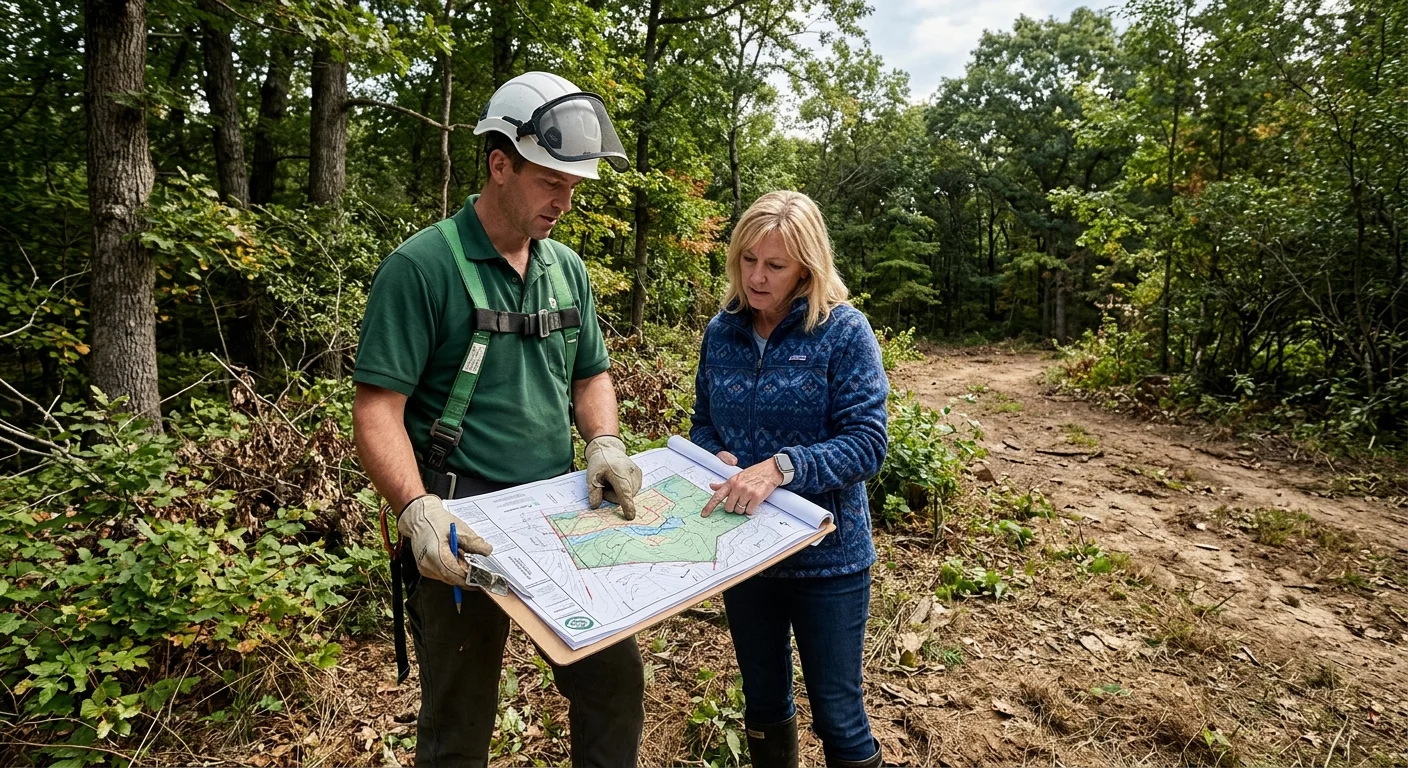
Land clearing before building should start with a site plan that names the planned use, what stays, what leaves, access, hauling, and the finish you want. That written scope gives the owner, designer, builder, and clearing company the same reference. It also surfaces tree, utility, and permit questions before vegetation comes off.
Define the planned use before clearing begins
Start with the result the building project needs. “Clear the lot” is too broad. It does not say whether work is limited to a pad, an access route, or another marked part of the parcel.
The clearing plan should identify the proposed use without replacing the project’s formal drawings. Mark the planned building area, areas that must remain undisturbed, and space reserved for access or staging. If those locations are not set, label them as pending. Do not let a clearing contractor guess where construction boundaries belong.
Write down what clearing means on this job. It could be selected trees, brush, surface vegetation, existing wood piles, or material already down inside the marked area. List each item separately. That keeps an undefined phrase from growing once work starts.
Local context belongs on the plan. A tight parcel in San Diego is a different access problem than a larger backcountry property near Ramona or Julian. Note neighboring structures, retained landscaping, gates, and any area that should not be crossed. These are site observations, not permission to clear.
Use the same scope when you discuss land clearing services. Compare written limits and final condition, not just the heading. Comparing land-clearing companies in the San Diego backcountry explains what to place side by side.
Map trees, brush, slopes, structures, and access
A useful plan shows what is present before it describes what should change. Begin with an existing survey or project drawing when you have one. A hand sketch can support an early conversation. It is not a surveyed plan.
Mark the visible conditions that affect the proposed scope:
- Individual trees or clearly defined tree groups
- Brush and other vegetation areas
- Deadwood, logs, or existing debris piles
- Stumps that are visible at the surface
- Buildings, sheds, fences, walls, and gates
- Sloped or uneven portions of the parcel
- Driveways and proposed access points
- Overhead lines, poles, and nearby utilities
- Neighboring improvements close to the work area
- Areas that must remain untouched
Give major trees simple identifiers such as T1, T2, and T3. Pair each identifier with a decision: retain, assess, remove, or undecided. If species or condition is not confirmed, write unknown rather than guessing. A professional can then inspect the actual tree.
Use the same approach for brush. Outline the area instead of “heavy brush” or “back section.” Show where the clearing limit stops. If that boundary depends on the designer, surveyor, utility, or public agency, mark it as pending confirmation.
Access deserves its own marking. Record gate locations, nearby structures, visible obstacles, and surfaces the owner wants protected. The clearing company can then evaluate the work area and propose its method. The site plan should not prescribe equipment or claim a route is suitable unless the responsible project professional has confirmed it.
Photographs can supplement the plan. Take them from a safe position on the ground before you plan the work. Don’t approach a damaged tree, a damaged building, or a line. Don’t try to survey a conductor. Label each image with its direction and matching plan area. Photos explain current conditions. They do not replace accurate boundaries or written instructions.
Separate tree assessment from brush and debris removal
Trees should not disappear into a general brush line. A standing tree may need an assessment, a removal decision, and a separate work scope. Brush and loose debris need different descriptions. Keeping those categories apart makes each company’s responsibility easier to see.
For every significant tree, record the next step. Some trees sit outside the planned work area. Others conflict with the proposed use. An uncertain tree can be marked for evaluation before the owner authorizes tree removal.
If you want an arboricultural opinion, ISA Certified Arborist is a professional certification for a named person. It is not a California contractor license. Search the ISA credential directory for that name, and ask for a current digital certificate for the same person.
For paid tree and palm work, look up an active C-49 license, or an active C-61/D-49 issued before January 1, 2024. California requires a contractor license for tree service contracts of $1,000 or more, counting labor, materials, and other items together. Advertising as a contractor, hiring others, or splitting jobs to stay under that line removes the small-job exemption. Work that needs a building permit needs a license at any price. Confirm classification and status on the CSLB license lookup.
The written scope should name each authorized tree, the intended treatment, and any work held pending further review. It should also say who handles logs, branches, chips, and stumps. Clearing or grinding a stump is not a geotechnical sign-off. Grade, drainage, compaction, and foundation readiness belong to the project’s engineer, not a vegetation-removal line.
Define hauling and the final site condition
A clearing scope is not finished when it only says what gets cut. It should also say what happens to the material.
For each category, state the expected disposition:
- Brush removed from the property
- Branches and woody material hauled away
- Wood retained in a location selected by the owner
- Chips retained or removed
- Existing debris included or excluded
- Stumps left, ground, or handled under another scope
Do not combine soil, construction debris, household waste, and vegetation under one label. If those materials are present, list them separately and ask which items the proposal covers. Show where retained logs or chips may sit. The owner and project team should approve that location before work starts.
If oak wood may be infested, keep it on the property until a qualified pro sets a handling plan. Do not send suspect oak out as ordinary chips or firewood. UC’s goldspotted oak borer firewood guidance explains why local handling matters.
Describe the finish in observable terms. State whether the scope ends after selected vegetation is cut, after loose material is collected, or after specified stump work. Avoid words such as clean, ready, or buildable unless the contract defines them.
The company that would do the work sets its price after it sees the parcel and the written scope. Land-clearing costs in San Diego lists the questions that change a quote. Ask which facility would take hauled loads, then have the company confirm that yard’s current accepted materials and load rules before you approve hauling.
Which agency controls the parcel, and what else has to be checked?
A mailing city is not enough. Confirm whether the parcel is in an incorporated city or unincorporated County using the address and APN with the County community plan directory or that city’s planning desk. Lake San Marcos is unincorporated. Hidden Meadows and Twin Oaks Valley can sit in County islands among nearby cities. Fire district, water district, and postal city do not set the planning jurisdiction.
City of San Diego communities such as La Jolla, Rancho Bernardo, and Scripps Ranch use City tree and right-of-way rules, not a separate city hall. For City-maintained street trees, start with the City’s street tree maintenance process and Get It Done. A private crew’s availability is not authority to remove a street tree.
On unincorporated land, County PDS-800 treats clearing as destruction or removal of natural vegetation, including brushing and grubbing. Existing dwellings, previously improved acreage, MSCP or PAMA status, vacant land, and recorded open-space easements change what applies. PDS-261 is the companion clearing and grading review path. Fire clearing is still limited by property lines and the fire district’s written requirements. Grading and habitat rules can be separate. A fire-clearance letter does not authorize a building pad.
In an incorporated city, ask that city’s public works or development services about public trees, right-of-way trees, and any private-tree or development conditions that match the marked work. Do not assume a backyard tree needs no review.
Send the controlling authority the same packet you give the clearing company: parcel, site plan, proposed use, marked clearing area, tree list, and open questions. Ask which tree, vegetation, environmental, or grading approvals apply, and use the current form they hand you.
California Public Resources Code 4291 is the 100-foot defensible-space rule in State Responsibility Areas, to the property line when that is closer. Locally designated Very High Fire Hazard Severity Zones follow Government Code 51182 and the local fire authority. Confirm the address map with that department. Zone 0 is the first five feet around a structure. See CAL FIRE’s current defensible space guidance. The Board approved a final draft on August 19, 2026. As of September 5, 2026, the package was listed under review at the Office of Administrative Law. Pending state filing does not exempt local rules. City of San Diego guidance allows maintained trees in that first five feet. Confirm current requirements and dates with the fire authority for the parcel.
California Department of Fish and Wildlife treats February through August as typical nesting for many birds, with timing that varies by species and place, and nesting possible in other months. If birds could be nesting, a consulting biologist can survey before vegetation comes off and may set a buffer or wait until nesting is complete. Do not move nests.
Utilities, DigAlert, and when to stop for emergency lines
Flag overhead conductors and poles on the plan. Do not send a crew into a restricted electrical area.
If a line is down, stay away. From a safe place call 911 and SDG&E at 1-800-411-7343. Follow SDG&E downed-line guidance. If a standing tree is into lines, call SDG&E before cutting. If someone is hurt or the scene is unstable, call 911 first.
Before powered grinding, grubbing, or root work, the qualified contractor should contact DigAlert at 811. San Diego County is inside DigAlert. DigAlert’s safe-digging steps are premark, contact, wait for every response, and respect the marks. The contractor exposes conflicting utilities before powered work. Marks show member-owned facilities, usually to the meter. They do not prove depth, and they do not cover every private line or nonpressurized drain. Arrange a separate locate for private facilities. A homeowner exception does not apply when the work uses powered equipment or needs a permit.
When to call us
Call when the plan includes tree removal, uncertain tree conditions, or clearing that needs a licensed tree service professional. Branch Pro San Diego connects you with licensed, insured independent tree service professionals. You hire and pay the pro directly. Call (858) 400-4423.