Most San Diego tree removals use rope-and-rigging, where a climber dismantles the tree piece by piece and lowers each section with ropes. Crane-assisted removal costs more per job but is the right call when a tree is dead or decayed, hangs over a house or pool, sits on a canyon slope, or leaves no safe spot to drop a limb. If you’re not sure which method your tree needs, call Branch Pro San Diego at (858) 400-4423 and we’ll walk the property with you before quoting anything.
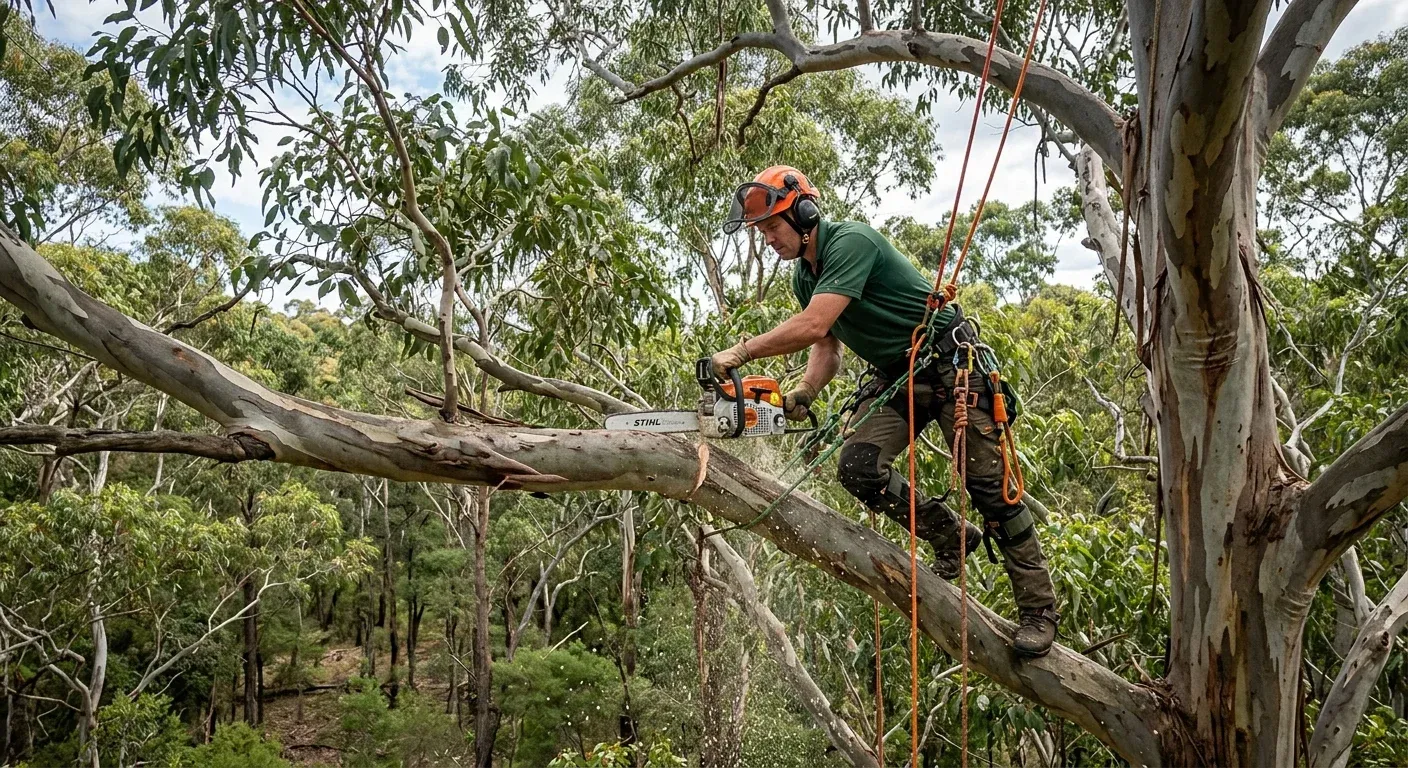
Two ways to take down a tree
Every tree removal comes down to one of two approaches. A climber goes up with ropes, saws, and rigging gear and takes the tree apart from the top down. Or a crane lifts the whole tree, or large sections of it, straight out and sets them on the ground or on a truck. Both are legitimate methods. The right one depends on the tree, the site, and what’s underneath it.
Rope-and-rigging: the default for most removals
For the majority of tree removals we handle across San Diego County, rope-and-rigging is the standard approach. A certified climber ascends the tree, cutting it down in manageable sections and controlling each piece’s descent with rope systems anchored above. It works well when there’s reasonable space around the tree, the wood is sound enough for a climber to trust with their weight, and there’s a clear spot to lower material.
It’s also the more affordable option. No crane mobilization fee, no street closure permit, no extra equipment operator on site. For a standard backyard tree in Chula Vista or El Cajon with room to work, rope-and-rigging gets the job done safely and efficiently.
Crane-assisted removal: when equipment beats a climber
A crane isn’t an upgrade for the sake of it. It solves specific problems a climber can’t solve safely.
Dead or decayed trees
If a tree is dead, hollow, or structurally compromised, sending a climber up into it is a real risk. Wood that looks solid from the ground can be soft or cracked internally. A crane lets the crew rig and lift sections from the ground, removing the tree without anyone’s weight resting on questionable wood.
Trees over a house, pool, or tight yard
Some yards simply don’t have a drop zone. A tree pinned between a house, a pool, and a fence line, common in older La Jolla and Del Mar neighborhoods, doesn’t leave room to lower even a small limb without real risk to the property. A crane lifts sections straight up and out, over the obstacle, instead of threading them down through a tight space.
Canyon and slope lots
San Diego’s canyon terrain and hillside lots create access problems standard rigging can’t solve. A tree growing out of a steep slope in Poway or Rancho Santa Fe might have no stable ground for a climber’s rigging anchors or a safe lowering path at all. Cranes set up on the street or a flat pad and reach in without a crew needing to work the slope itself.
Very large or heavy species
Mature eucalyptus and large pines can carry sections too heavy or too tall for standard rope rigging to lower safely. Read more about the specific risks these trees pose in eucalyptus tree dangers in San Diego. When a tree’s size outpaces what a rigging crew can control by hand, a crane becomes the safer and often faster choice.
Cost differences and why cranes cost more
Crane-assisted removals cost more because they involve renting or operating specialized equipment, an operator, often a street permit, and more coordination on site. Rope-and-rigging costs less because it’s just skilled labor and standard gear. Neither price is the “correct” one on its own. The cost difference reflects what the job actually requires. Trying to save money by rigging a tree that genuinely needs a crane just shifts the risk onto the climber, not the invoice.
If a tree happens to be growing near utility lines, that changes the calculation further. Take a look at trees near power lines in San Diego for how that risk factors into the method a crew chooses.
How to know which your tree needs
You generally don’t need to guess. A qualified crew will walk your property, look at the tree’s health, size, lean, and surroundings, and tell you honestly whether rope-and-rigging is sufficient or whether the job calls for a crane. Be wary of a quote that assumes rigging on a tree that’s clearly dead, oversized, or sitting over your roof. That’s a corner cut for a lower bid, and it’s the kind of corner that turns into property damage. For a deeper look at exactly when equipment is warranted, see when is crane-assisted tree removal necessary.
Our crane-assisted removal service exists for the jobs that genuinely need it, and our standard tree removal crews handle the rest with the same trained eye for what’s safe.
Want a straight answer on your specific tree? Call Branch Pro San Diego at (858) 400-4423 and we’ll tell you which method your property actually needs.
Frequently asked questions
Is crane-assisted removal always safer than rope-and-rigging?
Not automatically. Rope-and-rigging is very safe for healthy, accessible trees handled by trained climbers. A crane becomes the safer option specifically when the tree is unstable, oversized, or positioned over a target a climber can’t safely rig around.
Why does crane removal cost more than standard removal?
Crane work involves specialized equipment, an operator, setup time, and sometimes street permits. That added cost reflects real equipment and labor, not a markup.
Can a crane remove a tree without damaging my yard?
In most cases, yes. Cranes lift sections straight up and away rather than dragging them through the yard, which often causes less ground disturbance than a rigging job in a tight space.
How do I know if my tree is too dangerous for a climber?
Signs include visible decay, hollow sections, cracked limbs, significant lean, or fungus growth at the base. Any of these should trigger a professional assessment before anyone climbs the tree.
Does Branch Pro San Diego offer both removal methods?
Yes. We run standard rope-and-rigging crews for most removals and bring in crane-assisted removal for the jobs where it’s genuinely the safer or more practical choice.