A Solana Beach side yard often leaves a few feet between the fence and the eaves. That is where the tree sits, and that is why a beach tree service quote lives or dies on access. Name the cuts, the haul path, and who owns the tree before anyone brings a chipper to Highway 101.
Define the pruning goal for the specific tree
Start with one tree and one job. “Trim it” is not a scope. A written goal names the species if you know it, the parts that come off, and what stays. Clearance over tile. Light to a west window. Dead wood only. Size reduction that keeps the tree’s form. Those are different jobs, and they price and rig differently on a tight lot.
Structural pruning is purpose-based. The International Society of Arboriculture’s mature-tree guidance treats 25 percent live-crown removal as a general upper limit, and less than that for a mature tree. It is not a yearly quota. Each cut needs a reason. Routine thinning does not automatically make a tree healthier. Lion-tailing, which strips interior and lower foliage and leaves tufts at the ends, weakens structure. Topping, which cuts to stubs or to laterals that cannot take the load, is a different and harmful practice. If a quote only says “take it down by a third,” ask what that means on this canopy.
Palms are not shade trees. On a queen palm, dead and dying fronds and fruit clusters are the usual work. Healthy foliage should stay. A pineapple head or a skinny “hurricane cut” is overpruning, not extra safety. A Canary Island date palm with one-sided decline needs diagnosis, not a cosmetic pass. If Fusarium wilt is in play, contaminated tools can spread it. That is a disease question, not a haircut.
Coast live oak, eucalyptus, ficus, and jacaranda each fail in different ways. An oak with crown thinning is not automatically goldspotted oak borer. GSOB is contributing to oak mortality in many parts of San Diego County, but staining or thin foliage alone is not a diagnosis. Eucalyptus longhorned borer signs are not a license to strip the crown. Ask the independent pro to state the objective in plain English: which branches, how far back, and why.
If the real problem is a hanging limb, a fresh lean, or a split, stop treating it as maintenance. Stay clear and have a qualified company assess it. Pruning is not a substitute for removal when the remaining tree cannot be made acceptable. Agree that in writing before work starts.
Map access around roofs, fences, and neighboring property
West of I-5, Solana Beach lots get small fast. Older blocks near Highway 101, Cedros, and Fletcher Cove often stack a house, a walkway, and a mature canopy on a footprint that would be a setback inland. Lomas Santa Fe and the canyon-edge streets add slope and a second story. The chipper usually stays on the street. Wood comes down in pieces and walks out.
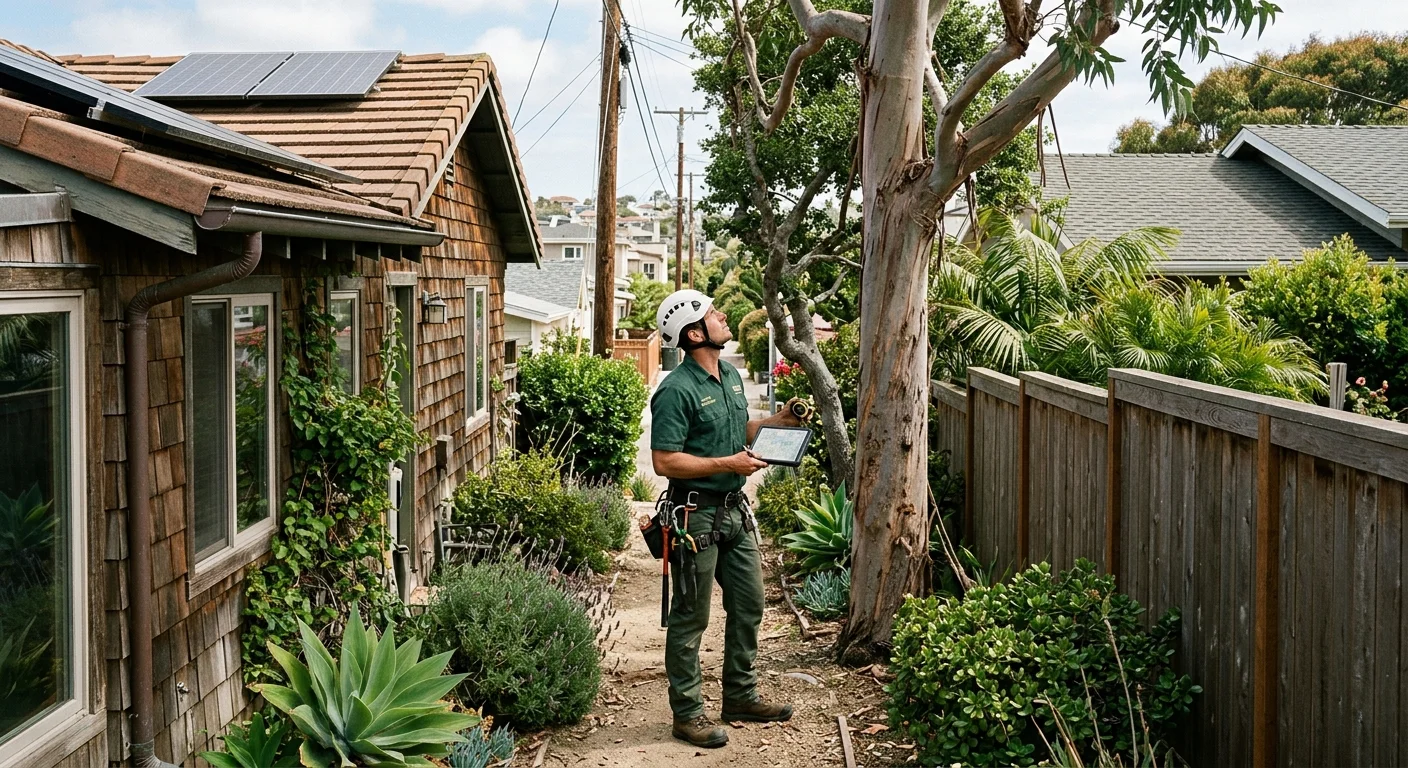
Walk the lot the way a crew will. Measure the side yard at the tightest point, not at the gate. Note tile eaves, skylights, solar, AC pads, glass, and irrigation. Note the fence type and who appears to own it. A fence is not a survey. California Civil Code sections 833 and 834 put ownership with the trunk. Roots or branches that cross a line do not make the whole tree yours to cut. Booska v. Patel is the reminder that a property line is not a free pass to sever roots without care. Do not trench, do not send a saw over the line, and do not treat “it hangs over my patio” as permission.
If the only drop zone is the neighbor’s driveway, that is a consent and insurance problem, not a courtesy. Get written permission for any entry, parking, or landing on the other lot. Parked cars on 101, Cedros, and the residential streets west of the freeway will eat a work day if nobody plans around them. Trash and recycling days can close an already thin curb. Tell the company the pickup day when you ask for a quote.
Overhead service drops and alley or rear-lot lines change the whole plan. Do not guess voltage from height or insulation color. If branches are in conflict with lines, SDG&E decides whether a drop can be de-energized, covered, or moved. Unauthorized work near high-voltage lines is not a homeowner or ordinary trimmer task. Keep people and tools away from a downed line and call 911 and SDG&E at 1-800-411-7343.
A crane is not automatic because the lot is small. Ground support depends on slope, compaction, drainage, and what sits under the street or patio. Tanks, laterals, and known voids have to be on the table. Ask how wood will come down if a lift cannot fit. Carry-out and rope-and-rig is the usual answer on these lots. Put that method in the quote so you are not arguing about it on the curb.
Document coastal exposure and the tree’s current condition
Solana Beach is not Escondido. Salt spray, marine layer, and a west wind off the water are the daily climate. Santa Ana events still reach the coast through the inland valleys, so a tree that looks “beach-sheltered” can still take a dry, gusty hit. That mix is why coastal and inland trimming are not the same conversation.
Salt injury can brown leaf tips and margins, sometimes more on the ocean-facing side or on foliage wetted by sprinklers. Root-zone salts are a different path. Drought, poor drainage, and salt can look alike from the sidewalk. A brown canopy is not an instruction to water more, and it is not an instruction to strip live wood. Have someone check soil moisture and irrigation coverage before you buy a “thin it for wind” job.
Photograph from the ground, from a safe place. Shoot the full tree, the tight side yard, the roof relationship, the street parking, and any line conflict. Do not climb, do not circle an unstable tree, and do not pull on hanging wood for a better picture. Notes that help a quote: species if known, recent construction, irrigation changes, and whether the tree sits on a bluff, a flat 101-adjacent lot, or a slope off Lomas Santa Fe.
Condition and pruning goal have to match. A tree already missing interior foliage does not need another round of lion-tailing. A palm with a green crown can still have hidden trunk problems. ISA’s palm guidance is to keep healthy fronds, protect the terminal bud, and skip spikes, which permanently wound a trunk that will not close. None of that is a guarantee the tree is sound.
Bird nesting can affect timing. California Department of Fish and Wildlife describes February through August as typical for many species, with variation by species and location, and nesting in some places every month of the year. That is agency guidance, not a Solana Beach permit. If work must happen when birds could be nesting, a consulting biologist’s survey is the recommended path. Do not move or poke nests.
Separate pruning, hauling, cleanup, and excluded work
Tree trimming and pruning are not two different biological processes. Industry pruning standards cover risk, health, structure, clearance, and appearance. The useful split is the written objective, not the word on the invoice. Compare scopes the same way: named cuts, access method, and what leaves the property.
A complete quote for a narrow Solana Beach lot should list:
- The tree and the objective, in ordinary language
- Live wood versus dead wood
- How pieces come down and where they land
- Whether wood, brush, and chips are hauled
- Who protects the roof, fence, and hardscape, and how
- Staging on the street or in the right-of-way
- Work that is not included
Hauling is its own line. A crew can prune and leave a brush pile. Chips can stay as mulch if you want them, but they are not automatically safe against a structure, and they are not a defensible-space plan. Stump grinding, root pruning, cabling, pest treatment, and replanting are separate unless the paper says otherwise. Pesticide work is a Department of Pesticide Regulation pest-control business issue. A C-49 or legacy C-61/D-49 contractor license does not replace that.
Cleanup means the surfaces you care about. Tile, pea gravel, a narrow concrete walk, and a wood fence all trap debris differently. Say whether the patio, the neighbor’s side, and the parkway strip are in scope. Say who moves cars, furniture, and bins. Say whether irrigation heads get flagged before anyone drags brush.
Price belongs on the independent company’s written proposal. Branch Pro San Diego does not set fees and does not publish a market rate here, because no official source gives one. Ask for the method, the exclusions, and the certificate of insurance. A certificate is not the policy. California Insurance Code section 384 says coverage follows the policy terms, not the piece of paper. Verify the contractor on the CSLB license lookup. For contracts of $1,000 or more, California requires a contractor license. Tree work of that size is a C-49 Tree and Palm classification, or a valid legacy C-61/D-49 issued before January 1, 2024. ISA Certified Arborist is an individual credential, not a state license, and an absent directory listing does not by itself disprove it.
Check city or utility responsibility before approval
Confirm whose tree it is before you approve a cut. A mailing address in Solana Beach does not settle it. The trunk may sit in a parkway, an easement, or a neighbor’s yard.
For a public tree, Solana Beach Engineering and Public Works says removal requires City Manager approval and a temporary encroachment permit. The city’s Engineering and Public Works FAQ also covers planting and work in the right-of-way. That is the public-tree path. It is not a blanket rule that every private backyard tree is exempt, and it is not a fee or timeline. Confirm the parcel, the tree’s location, and the scope with the city before anyone cuts. If equipment or a chipper occupies the right-of-way, ask about encroachment even when the tree itself is on private land.
Do not hire a private crew to take down a city tree on a contractor’s say-so. City of San Diego street-tree rules do not apply here. Solana Beach is its own city. Del Mar, next door, has a different tree FAQ that singles out Torrey pine and Monterey cypress. If your lot sits near that line, verify the jurisdiction.
Utility vegetation on high-voltage lines is SDG&E’s program, not a homeowner clearance tutorial. If the conflict is a service drop under strain, the current SDG&E tree-safety FAQ allows customers to request de-energizing of that drop, with the utility’s own scheduling rules. Confirm the arrangement with SDG&E. Do not treat a 10-foot warning as permission to prune to that distance.
If later work includes grinding or digging, DigAlert covers San Diego County. Public marks usually run to the meter, not to every private lateral, and they do not give depth. Private lines need a separate locate.
Solana Beach tree service pages on this site are a starting map of the city, not a permit. The independent company you hire is the one who walks the lot. Branch Pro San Diego matches you with licensed local pros. It does not pull permits, own the trucks, or do the cuts.
Frequently asked questions
Do I need a permit to prune a tree on a Solana Beach lot?
It depends on whose tree it is and where it stands. Public-tree removal needs City Manager approval and a temporary encroachment permit. Private trees are not automatically free of review. Confirm the address, the trunk location, and the work with Solana Beach before you approve the job.
Can the crew use my neighbor’s yard?
Only with that owner’s clear permission. Trunk location controls ownership. Crossing a fence for landing, climbing, or haul-out is access, not a right. Put permission in writing. A matched crew should not treat a shared fence as a work platform.
Is topping cheaper on a tight lot?
Topping is a poor structural choice. It leaves stubs, sun-scalded tissue, and weakly attached sprouts. On a small Solana Beach lot those sprouts become the next clearance problem. Ask for reduction to real laterals, or for a keep-versus-remove decision, not a flat-top.
What should I send with a quote request?
Ground-level photos of the whole tree, the side yard, the roof, the street parking, and any lines. The trash day. Whether you can be on site. The written goal: clearance, dead wood, or a named reduction. That is enough for a serious company to decide if they need to walk it.
When to call us
Call when the tree is tight to a Solana Beach roof or fence, when access is a side yard instead of a driveway, or when you cannot tell if the tree is yours, the city’s, or the utility’s. Call us at (858) 400-4423 and we’ll connect you with a licensed local tree company.