A limb on a roof along Mapleview, or a trunk across a driveway off Highway 67, is a reporting job before it is a cutting job. The independent company you hire cannot quote well if they only hear that a tree fell. Tell them what moved, what it is resting on, and whether anyone can still get in or out.
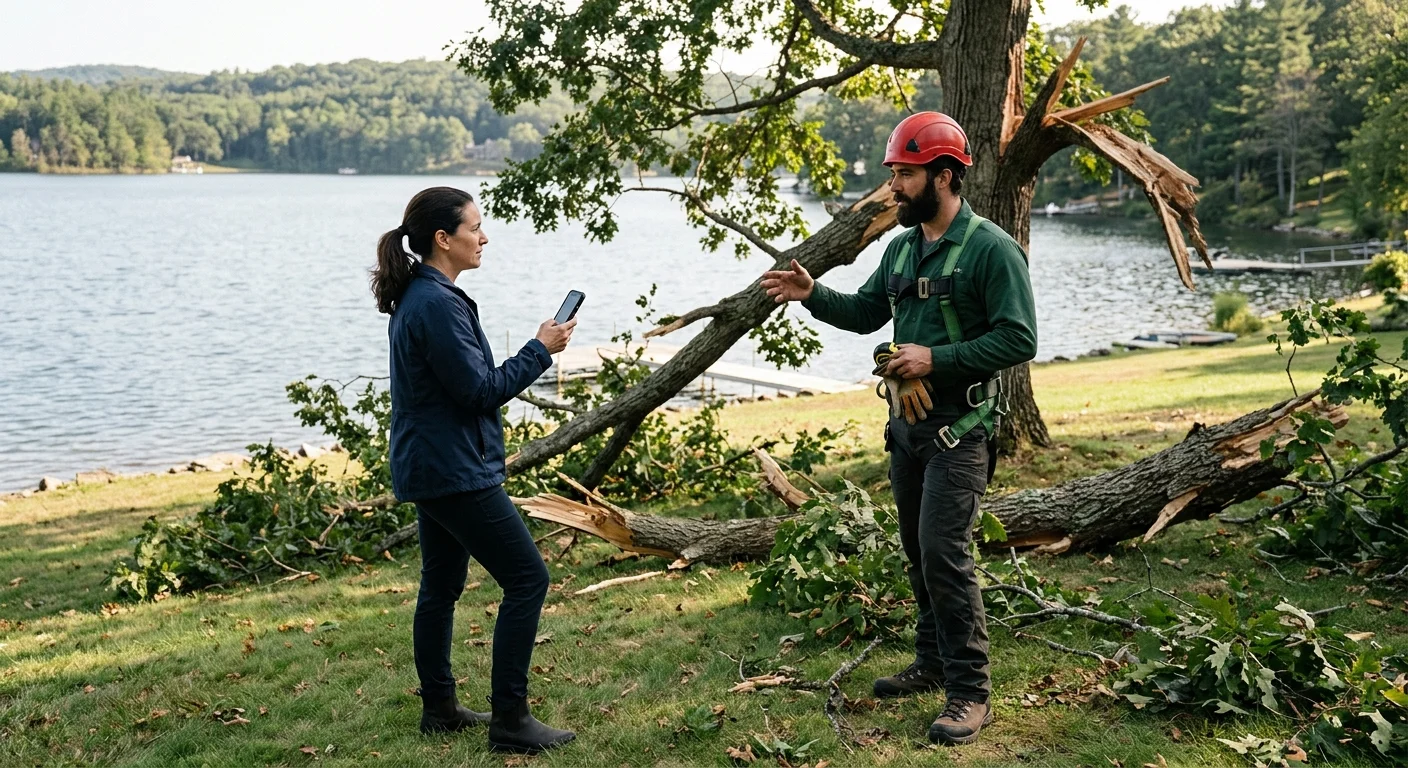
Describe what changed and what the tree is blocking
Lakeside is an unincorporated San Diego County community, not a separate city with its own tree desk. Lots along Woodside Avenue, Winter Gardens Boulevard, Lake Jennings Park Road, Riverford Road, and El Monte Valley sit on slope, canyon edge, or a wider ranch pad. That layout changes the call. A coast live oak that dropped one limb over a patio is not the same job as a eucalyptus that split and now sits on a garage. Start with the change you can see from a safe place.
Say whether the tree was standing yesterday and is now down, hanging, or newly leaning. A long-standing lean is useful context. It is not the same as a fresh shift after wind. Name the species if you know it. Oak, eucalyptus, pine, and palm all cut and haul differently. If you do not know the species, say so. Guessing does not help.
Then name what the tree is blocking. House, garage, ADU, barn, parked cars, a well or pump pad, a fence, a shared private road, or the only driveway out to Mapleview or Highway 67. If the tree is in the public right-of-way, that is a different owner than a backyard tree. A Lakeside mailing address can sit next to incorporated Santee or El Cajon. Jurisdiction follows the parcel, not the post office.
If any part of the tree is on or near electric lines, stop. Stay away. Call 911 and SDG&E at 1-800-411-7343. SDG&E, not a tree company, decides whether a line can be de-energized, covered, or moved. Do not treat a quiet line as a safe line. Our emergency tree service page is for private-tree work after that utility step, not instead of it.
People and pets stay out of the failure zone. Do not cut, winch, or climb. Tensioned wood can move. The first report is what failed, what it rests on, and who still has a way out.
Document the tree, driveway, roof, and nearby structures
Photos help a licensed independent crew plan access. Take them only from ground you already trust. Do not walk under hung limbs, circle a lifted root plate, or climb onto a damaged roof for a better shot. If the tree is still moving, skip the photos and keep people back.
From a clear spot, capture the whole tree against the house or driveway. Then a closer shot of the break, the lean, or the root plate. Include the roof, fence, and any structure the wood is touching. Show the driveway, gate, and the turn from the street. East County lots off Highway 67 often have a long, narrow drive, a slope, or a tight pad with no crane room. That is as important as the species.
Note overhead lines, the meter, and anything a truck would hit. Public utility marks do not show every private irrigation line or sewer lateral. If later work includes grinding or digging, the company should use DigAlert for member utilities and a separate locate for private lines. Marks do not give depth.
Write a short list while it is fresh. Approximate height and trunk size in plain terms: as wide as a dinner plate, or too thick to wrap both hands around. How many stems. Whether the wood is on the roof, beside it, or only in the yard. Whether the driveway is fully blocked or one car can still squeeze out. Whether a neighbor’s fence or car is involved. Ownership follows the trunk under California Civil Code 833 and 834, not the fence line. A fence is not a survey.
If the tree damaged the house, call your insurer when you can do it safely. California Department of Insurance guidance is that damage to the insured home from a fallen tree is generally covered, subject to the policy and its exceptions. Vehicle damage generally goes through optional comprehensive auto coverage, not the homeowners policy. Limits, deductibles, and debris allowances are policy-specific. Ask the adjuster which clause applies. Do not wait in a dangerous spot only to take pictures. Our countywide emergency tree removal guide covers the same order of operations without Lakeside’s roads and County jurisdiction.
Separate immediate access needs from the full removal scope
The first need on many Lakeside lots is a path, not a finished landscape. A trunk across the only drive off Woodside or a private road above El Monte Valley can trap a household. Opening that path is a defined scope. Taking the rest of the tree down, grinding the stump, and hauling every chip is another. Mixing them on the phone produces a quote that does not match the yard.
Tell the company what has to move first. Clear the drive so a car can leave. Get wood off a roof so a roofer can tarp. Free a gate. Leave standing trunks, hanging pieces, and wood on a slope for the on-site plan. Do not ask a caller to promise that the whole tree comes down in one visit. The independent provider confirms duration after they see access and rigging.
Full tree removal on a Lakeside lot can mean sectional dismantling in a tight backyard, or a lift if there is room and firm ground. Slope, clay, and underground utilities affect crane setup. California crane rules look at ground support, drainage, and known voids. Mats are not a guarantee against yard damage. Ask whether the quote includes a crane, a climber, or both, and who decides after the walk-through.
If the tree can stay, say that. A broken limb is not an automatic felling order. A qualified inspection can separate a hangers-and-cleanup job from a removal. Do not treat color change, bark stain, or a lean as a home diagnosis. Goldspotted oak borer is contributing to oak mortality in many parts of San Diego County. That is background for Lakeside’s oak stands. It is not a reason to order a removal from a photo.
After the wood is off the house, fire-clearance work is a separate conversation. Lakeside sits toward East County chaparral. Confirm the parcel’s fire authority and current defensible-space rules at CAL FIRE’s Ready for Wildfire guidance. Statewide Zone 0 rules were still in review as of early September 2026. Do not strip the first five feet on a rumor, and do not treat an emergency cut as a finished fuel-break plan.
Ask how debris, hauling, and stump work are handled
A Lakeside quote that says “remove the tree” can still leave a driveway full of rounds. Ask, in writing, what leaves the property. Cut and drop in place. Chip on site and leave chips. Haul logs. Haul brush. Rake the lawn. Those are different line items. On a slope lot above a canyon, leaving heavy wood can be a later problem, not a savings.
Ask where trucks will stage. Highway 67 frontage, a shared easement, and a dirt drive off Lake Jennings Park Road all constrain chippers and trailers. If the work occupies the public right-of-way, that can need a County or road-agency step. A private backyard job that never leaves the lot is different. Confirm the actual location of the tree, not just the mailing city.
Stump work is easy to skip on an emergency call and expensive to redo. Grinding is not the same as digging the root mass. Grinding does not prepare a pad for a slab. If you plan to replant, say so. Remaining roots, old soil, and prior pests matter. Same-spot planting needs more than a ground stump. If you only need the drive usable, say that too, so the company does not bid a landscape finish you did not ask for.
If grinding or excavation is in the scope, utilities come first. DigAlert covers San Diego County. Homeowner exceptions are narrow: your own private property, no permit, and no powered equipment. Member marks usually run to the meter, not every private line. Do not assume a line is deep enough to grind over.
Open burning is not a cleanup plan. The San Diego Air Pollution Control District does not issue burn permits. Local fire authorities do, and many suspend residential burning. Do not treat a pile of oak or eucalyptus as firewood to move around the county if pest risk is in play. Keep suspect oak wood on site until the company explains handling. There is no verified countywide “drive it ten miles” rule to publish.
Verify availability and the independent contractor before approval
Branch Pro San Diego is a referral service. We match you with licensed, independent local tree companies. We do not send our own crew, own trucks, or set the price. The company you approve does the work, bills you, and stands behind its own scope. Ask that company when they can be on site. Do not treat a phone connection as a dispatch clock.
Before you approve, get the proposal in writing. Immediate access work, remaining takedown, haul-off, and stump work should be separate or clearly bundled. Ask what is excluded: roof repair, fence rebuild, irrigation, grade, and permit filing. A certificate of insurance is not the policy. California Insurance Code section 384 says coverage follows the policy terms, not the certificate.
Check the license on the CSLB license lookup. Tree work of $1,000 or more generally needs a contractor license. The current classification is C-49 Tree and Palm. An active legacy C-61/D-49 issued before 2024 can still be valid. Do not reject a current D-49 solely because the card does not say C-49. Confirm status, expiration, and the classification that fits the job.
Every active California contractor must have a $25,000 license bond, or a lawful deposit in lieu of it. That bond is not general liability and not workers’ compensation. Workers’ compensation depends on whether the company has employees. C-49 is not on the current no-exemption list. Legacy D-49 is. Read the CSLB workers’ compensation record and ask how the job will be staffed. ISA Certified Arborist is a personal credential, not a state license, and not proof that every person on site holds it. You can look up an individual through ISA’s TreesAreGood resources. An absent listing does not by itself disprove a credential.
For a fuller checklist on what to ask an independent company, including after-hours claims, use how to verify a tree service before you hire. Then hire against the written scope, not a verbal “we’ll take care of it.”
Frequently asked questions
How much is emergency tree service in Lakeside?
No government source publishes a Lakeside emergency tree price. Aggregator averages are not a bid. Cost follows access, height, what the tree is resting on, crane or climbing, haul-off, and stump work. Ask the independent company for an itemized written quote for this address. Do not approve a number that was not tied to that scope.
Who do I call if a tree is down in my yard?
If anyone is hurt, or if lines are down or involved, call 911. For electric lines, also call SDG&E at 1-800-411-7343 from a safe place. For a private tree on a Lakeside lot with no line conflict, call a licensed tree contractor, or call us and we will match you with one. County Planning at PDS can tell you whether the parcel, easement, or native vegetation needs review. The fire authority for the address handles fire-clearance questions. Those are not the same call as a takedown quote.
How do I get a tree taken down for free?
Branch Pro does not waive fees or promise free removal. Some insurers pay to remove a tree that damaged the insured home, within policy limits. A tree that fell only in the yard, with no structure damage, is a question for your carrier, not a guaranteed covered event. There is no verified county program that hauls private yard trees at no cost. If a company offers a free visit, that is their policy. It is not ours, and it is not a completed bid.
How much does it cost to just have a tree cut down?
“Just cut it down” still needs a method, a drop zone, and a plan for the wood. A take-down that leaves logs is cheaper on paper and can block the same drive you needed opened. Hauling, chipping, and stump grinding change the number. There is no official San Diego cut-down fee to quote. Put the end state in the proposal: wood gone, drive open, stump left or ground.
Do I need a permit for emergency tree work in Lakeside?
Lakeside is unincorporated. Confirm the APN with County PDS before you assume a private-yard tree needs no review. San Diego County-specific oak protection could not be verified as a single countywide ordinance. Native vegetation clearing, open-space easements, and the fire district’s written requirements can still apply. A homeowner calling a tree dangerous does not create a permit waiver. Public or right-of-way trees follow a different path than a backyard tree. Get the authority in writing when the location is unclear.
When to call us
If a Lakeside tree is on a roof, across a drive, or hanging over a target, you want a licensed independent tree company, not a neighbor with a saw. Call us at (858) 400-4423 and we’ll connect you with a licensed local tree company. We serve Lakeside and the rest of San Diego County. Stay clear of the tree and any lines until the utility and the matched crew say the work can start.