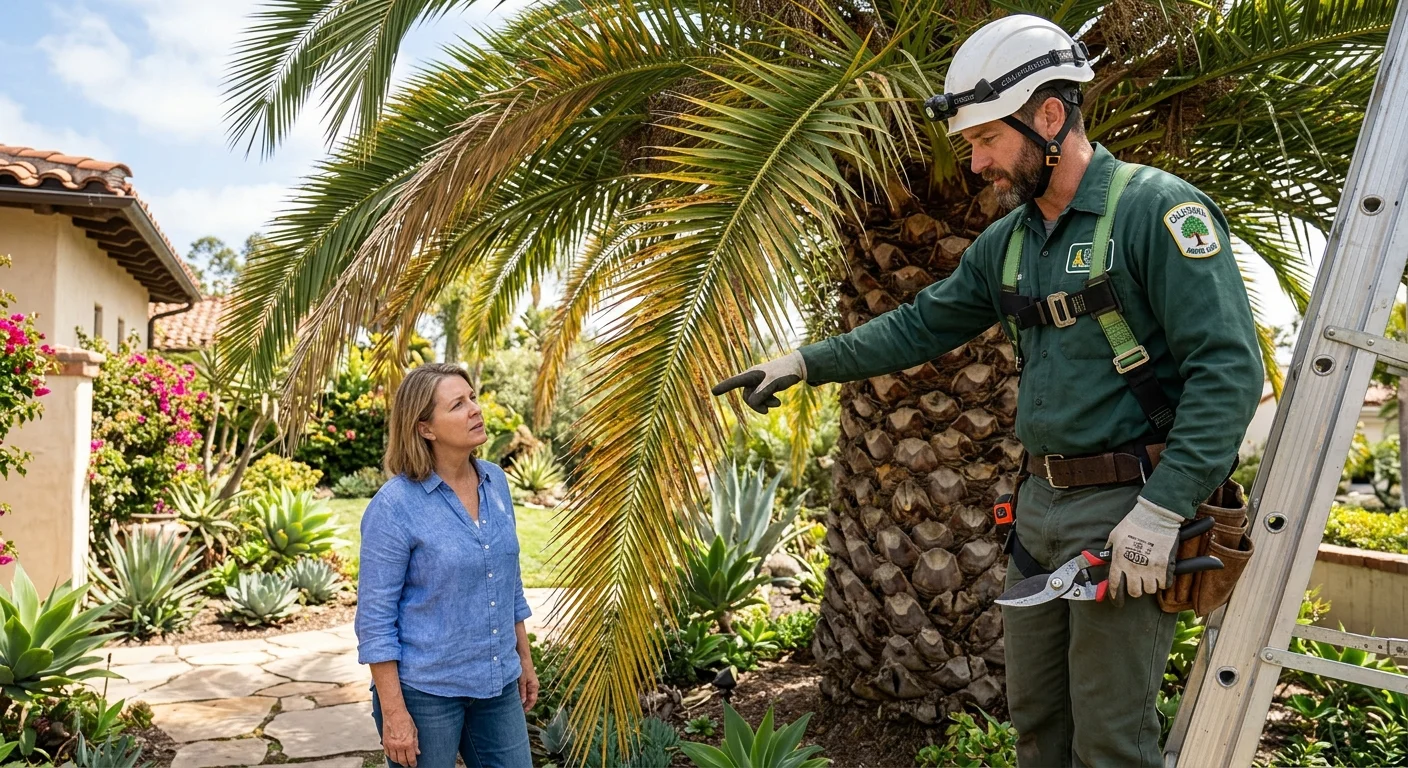
A yellowing San Diego palm is not one diagnosis. Fusarium wilt, fungal diamond scale, Ganoderma butt rot, petiole blight, and pink rot can look alike from the sidewalk.
Branch Pro San Diego is a referral service. We connect you with licensed, insured independent local tree professionals. You hire and pay the professional directly. We don’t diagnose, treat, prune, or remove palms.
Watch from the ground. Don’t climb, probe a trunk, or cut tissue to inspect it. If anyone is hurt or in immediate danger, call 911. If the palm is on a downed line, stay away. From a safe place, call 911 and SDG&E at 1-800-411-7343. SDG&E decides whether lines can be de-energized, covered, or moved. If a standing palm already touches overhead lines, call SDG&E first. Don’t prune toward an energized conductor.
How do these five palm problems differ?
Name the palm if you can. A Canary Island date palm in Coronado or La Jolla is a different host than a Mexican fan palm on a South Bay parkway. Our queen palm versus king palm guide helps with two common feather palms.
Matching a symptom is not a confirmed diagnosis. Get the cause identified before anyone removes a palm or applies a product.
UC IPM’s 2019 palm-disease guide covers Fusarium wilt, diamond scale, petiole blight, and pink rot. California Ganoderma records come from a 2025 PalmArbor report, not that 2019 guide.
Fusarium wilt. Fusarium oxysporum f. sp. canariensis causes lethal vascular wilt of landscape Canary Island date palms, with no established cure. One-sided leaflet death is a clue. Fusarium usually involves more leaves than petiole blight or pink rot. Contaminated tools and sawdust can spread it. Don’t cut a rachis open.
Diamond scale. The fungus Phaeochoropsis neowashingtoniae is not an insect and does not produce honeydew. UC observed it on California fan palms and Mexican-fan hybrids. Pure Mexican fan palms were not observed as hosts. Marine-influenced sites favor it. A palm near the water in Imperial Beach sits in a different air mass than one in inland El Cajon. Black diamond fruiting bodies and premature older-leaf loss are clues. Removing those leaves isn’t an established cure.
Petiole and rachis blights. Chiefly Cocoicola and Serenomyces on date and fan palms. They usually stress rather than kill. Limited leaflet or petiole death compared with a canopy-wide wilt. Water management and sanitation matter.
Pink rot. Nalanthamala vermoeseni is usually opportunistic on stressed or wounded palms. It can damage growing tips and produce pink spores. Trunk-decay causation remains unconfirmed. Fungicide alone is inadequate. Pink surface growth is not proof of Ganoderma.
Ganoderma butt rot. This is lower-trunk decay. Discoloration and decline overlap other causes. Conks can be absent. A green crown doesn’t prove the trunk is sound. California records are in the next section.
What should you know about Ganoderma butt rot in California?
Santos and Hodel’s March 2025 PalmArbor report documents California Ganoderma zonatum. CDFA sequencing confirmed it from a queen-palm stump after a November 2024 Laguna Hills investigation. A 2017 Carlsbad sample was later identified by DNA, but the host was uncertain: queen palm or Mexican fan palm. A 2007 San Diego Senegal-palm observation remained suspected, not confirmed.
Those records don’t measure how common the disease is in San Diego neighborhoods.
A random mushroom photograph doesn’t establish G. zonatum. Identification benefits from molecular methods. No established preventive treatment or cure is given. Removing a conk doesn’t cure the palm.
Confirmed affected palms need a removal and risk plan. Contaminated material shouldn’t go into recycling mulch. Replanting another palm on the same site is risky. Discuss a suitable non-palm replacement. Don’t grind, burn, or chemically treat a stump as a home cure. Poor drainage and pruning wounds aren’t proven causes of this disease.
Distinguish this lower-trunk rot from sudden crown drop. Sudden crown drop can occur with a still-green canopy, and its primary cause remains unconfirmed. Don’t tap or skin a trunk to test it.
Could it be South American palm weevil instead?
If a Canary Island date palm is declining, UC IPM’s giant palm weevil page is the insect differential.
South American palm weevil, Rhynchophorus palmarum, is established in San Diego County and can kill Canary Island date palms. Larvae bore inside the palm. Adults and moved infested plants or material spread it.
From the ground, binoculars can show feeding clues in the crown. Don’t climb into a suspect crown. Have a qualified professional inspect tissue you can’t see safely. Report suspected giant palm weevils to the San Diego County agricultural commissioner. Don’t apply insecticide on your own, and don’t treat infested material as ordinary green waste.
How should palms be pruned when disease is a concern?
Prune for a stated purpose. ISA’s palm brochure focuses on dead or dying fronds and on fruit or flower clusters when they create site risk. Retain healthy foliage. Limited clearance cuts, and some live fronds below horizontal, can be appropriate.
Don’t skin the trunk or sculpt persistent leaf bases. Those wounds don’t close. Protect the terminal bud. Spikes permanently wound a living palm. See palm tree trimming season for timing by species and objective.
For Fusarium-risk palms, debris cleanup and disease-specific disinfection belong with the professional and the current protocol for that pathogen. Don’t wipe tools with a home bleach or alcohol mix and call them safe.
If a product is part of a written plan, the product label applies. A professional should explain current label precautions and reentry. No person authorizes safety independent of the label.
A palm tree service referral starts with the actual species, access, and what you observed. It doesn’t promise a particular treatment or outcome.
When does a palm need a professional diagnosis?
When decline is one-sided, accelerating, or paired with crown or trunk change. When people or structures sit under the palm. When you can’t tell dead skirt from live tissue from the ground.
A tree health diagnosis referral can start that written assessment. An ISA credential belongs to a named person. If someone claims it, ask for that person’s current digital certificate. You can check the ISA credential directory. A missing listing doesn’t, by itself, disprove certification.
Frequently asked questions
Why is my San Diego palm turning yellow?
Older-frond aging, drought stress, nutrient issues, fungal disease, and insects can all yellow tissue. Photograph the whole palm, the newest fronds, and the trunk base from a safe distance. Then have the cause identified.
Should I remove a palm from one yellow frond?
No. Confirm the host and the cause first. Use the comparison above, then a written professional diagnosis.
Does a mushroom at the base mean the palm will fall?
Not by itself. A conk raises a structural question. Missing conks don’t prove the trunk is sound. Get a professional risk assessment.
Should I prune every palm every year?
No. Cut for a purpose. Keep useful living fronds. Hazardous hanging material isn’t a calendar job.
Call (858) 400-4423 to request a palm assessment referral. We’ll connect you with a licensed, insured independent local professional. Ask for a written diagnosis and scope before you approve work.
If you’re still naming the palm, start with queen versus king. For broader yard checks, use the spot a pest infestation checklist.